

Where Davie ends and its neighbors begin
Drive west through Davie and the town changes character in stages. Near the middle, streets are older and the houses are mostly single story. Closer to Weston Road, the pattern shifts toward planned communities, curving streets, wider setbacks and homes that tend to be larger. The road itself marks a boundary where Davie meets Weston to the north and the large lot ranch country of Southwest Ranches to the south, and many households here live within a short drive of all three.
That mix means a call from the western edge could involve almost anything. One day it is a newer two story house with several air conditioning systems and a pool in back. The next it is a larger lot where a workshop and a barn sit well away from the house. The common thread is that the properties here tend to be built on a generous scale, which affects how much power they use and how far it has to travel.
Many homes in this part of Davie were built in a relatively recent building era compared with the town center, so original wiring is often copper and the panels are usually breaker style. That is good news for safety. It does not mean everything is current, however. Households add electric vehicles, home offices, pool equipment, outdoor kitchens and backup power, and the original service was not always sized for the full list.
Distance from the older parts of town does not change who inspects the work. Permits and inspections for electrical projects go through the city building department, and the rules that apply can vary with the type of work and the property. A qualified electrician should confirm what is needed on site before work starts, and we are glad to explain the process in plain terms so there are no surprises midway through a project.
This page is one of several on this site about specific parts of Davie. If you are not sure where your street fits, start with our general page on electricians in Davie, Florida, or read about the neighboring Westridge and newer western Davie homes. Either way, tell us what you see in your own house, and we will work from there.
Working inside gated communities and associations
A large share of the housing near Weston Road sits inside communities with a homeowners association, a gate, or both. That shapes the practical side of any electrical job. Before a contractor can even arrive, the gate has to know about the visit. Many associations keep a vendor list, ask for the details of the contractor in advance, and limit work to certain days and hours. Giving us the community name and the gate procedure when you call saves a lot of back and forth.
Associations often have rules about exterior changes. A new generator, a pool equipment pad, a charger on the front wall, landscape lighting along the driveway or a new meter location can each require written approval from an architectural committee before any work begins. Approval and city permitting are separate things. You may need both, and neither replaces the other. It helps to ask your association what it requires and to get answers in writing.
Noise and equipment rules can matter as well. Some communities restrict generator placement, require screening, or set limits on when machinery may run. Standby generators are a good example, since they sit outdoors and run on a schedule for exercise. Our guide to standby generator and transfer switch installation covers how placement, clearances and the transfer arrangement fit together, which also helps when you present a plan to your board.
Townhome and villa groupings inside larger communities add another question. In some, the association maintains the exterior and common areas, and the owner is responsible for the wiring inside the unit. In others, the boundary is drawn differently. Read the governing documents or ask the property manager before assuming who owns a given wire, panel or fixture, because the answer decides who can authorize and pay for the work.
If the community has a shared gate operator, entry keypad or common area lighting, those are usually the responsibility of the association and are handled through its own vendors. We can help with the individual home side of the meter, and we can explain what we see when a problem seems to start outside your property line. We would rather tell you honestly that something is not yours to fix than lose your time.
If a project spans several owners, such as a shared drive or a common wall, tell us early. Boundaries between lots and between association property and private property are not always obvious from the street. Walking the line with the property manager before any wire is run keeps everyone clear on who is paying for what, and it avoids the unpleasant discovery that a trench has crossed ground that belongs to someone else or that a utility easement limits where equipment may sit.
Larger houses and the loads inside them
A bigger house tends to mean more of everything electrical. More square footage means more lighting, more outlets, longer wire runs inside the walls and often more than one air conditioning system. Tall ceilings and open great rooms put fixtures and fans where a ladder is needed to reach them, and they change how lighting is planned. A fan hung on a long downrod needs a properly supported box and a correct control, not simply a new blade set.
The service entering the house deserves a look when the household grows into the space. The panel serves everything: kitchen appliances, laundry, pool equipment, two or three air conditioners and a growing collection of electronics. When a panel is full, with no spare spaces and double breakers stacked in places they should not be, it is telling you something. Our page on panel upgrades and replacements explains why that matters and what options exist.
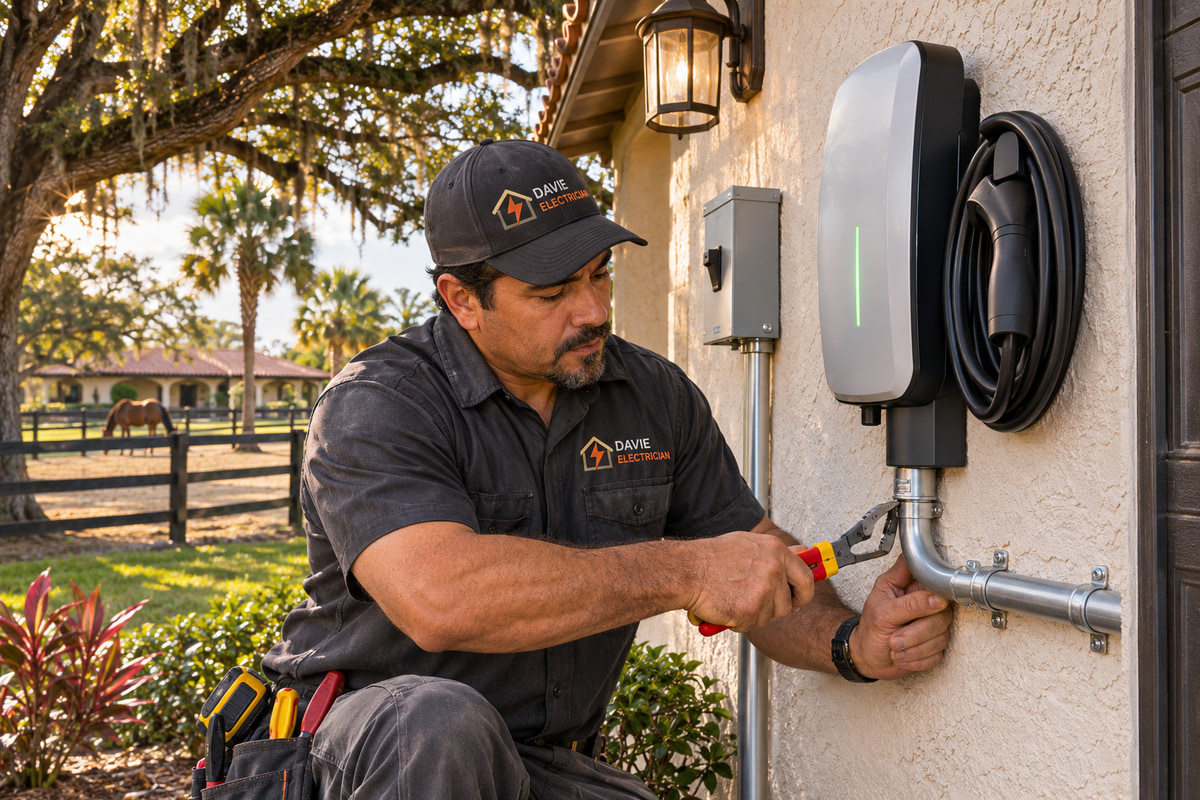
Garages in newer houses are often wired for the car and little else. The moment a household wants a car charger, a workbench or a second refrigerator, the circuit capacity becomes the limit. Adding a charger is a matter of matching the circuit to the vehicle and the panel, and it should be done as a dedicated circuit rather than through an extension cord or a household outlet. See our page on electric vehicle charger installation for the general approach.
Large kitchens with oversized ranges, double ovens, built in refrigeration and a pantry full of countertop appliances create heavy and specialized loads. Remodeling such a kitchen means thinking about dedicated circuits, ground fault protection near water and enough receptacles along the counters. Doing the electrical planning before the cabinets are ordered avoids the awkward situation where a new appliance cannot be connected without opening a finished wall.
Homes with finished outdoor spaces carry yet another load. Summer kitchens, ceiling fans on the lanai, television wiring, misting systems and lighting pull power through outdoor circuits that must be protected from wet and hot conditions. Planning these as a group tends to produce a tidier result than adding each one separately over several years, which is how many owners end up with a panel that no one can quite explain.
Pets, children and visitors are part of everyday life in busy family houses, which is why we mention small safety details during every visit. Outlets near sinks and the garage should have ground fault protection, smoke and carbon monoxide alarms should be powered and tested, and cords should never be run under rugs or across walkways. Our guide to child safety around outlets and cords has practical suggestions that cost very little to follow.
Lakes, canals and what storms do to power
Planned communities in this part of Broward are usually built around water. Lakes and retention areas hold and move stormwater, which keeps streets and yards drier, but it also means more moisture in the air, more frogs and insects, and more lightning attractive open ground. Houses along a lake edge often have long back yards that include pool equipment, outdoor lighting and a small shed or storage area near the water.
Lightning is a regular visitor to South Florida in summer, and the electrical effects are not limited to a direct hit. A strike nearby can send a surge through utility lines, telephone and cable wiring, and even through the ground. Sensitive electronics, garage door openers, pool equipment controls and air conditioner boards are common victims. Protection at the panel can reduce the stress. Our page on whole house surge protection explains the idea.
Heavy rain tests anything outdoors. Outlets that are not covered correctly, light fixtures that fill with water, and junction boxes that were never sealed all fail eventually. A ground fault breaker that trips every time it rains is not being difficult. It is doing its job and pointing at a place where water is getting in. Resetting it again and again without finding the cause hides the problem, and you should call someone to look instead.
When a hurricane or tropical storm approaches, the questions change. People ask about shutting off circuits, protecting the panel and planning for days without power. Our guides on getting your electrical system ready before hurricane season and what to do with your panel when a storm is forecast give general steps. Details depend on your own house, so it is worth asking us before the storm instead of during it.
After flooding, do not enter standing water near electrical equipment, and do not touch outlets, cords or panels that have been wet. If water has reached outlets or the garage, switch off power only if you can do so from a dry spot, and otherwise stay clear and call the utility or an electrician. If you ever see smoke, smell burning or notice sparks, call 911 first. Wet electrical gear generally needs inspection and often replacement before use.
Where houses give way to acreage and outbuildings
South and west of the planned communities, lots grow larger and the scenery changes. Fences replace shared walls, driveways grow longer, and properties begin to include barns, workshops, guest cottages, horse arenas and pump houses. This is the edge of what many people think of as ranch country, and the electrical needs are different from those of a typical suburban lot. Power has to travel farther, and the loads are often heavier and more varied.
Buildings far from the house are served most sensibly by a properly sized feeder ending at a subpanel, with its own grounding and protection. Running an extension cord or a thin cable to a barn is a common shortcut and a common cause of trouble. Our page on electrical service for barns, workshops and detached buildings explains how these buildings are served, and our blog covers the distance side of the problem in the guide to long wire runs on big lots.
Many acreage properties rely on a well and a pump rather than city water, and some have septic systems with their own electrical pieces. A pump that cannot restart after an outage, or one that trips a breaker when it starts, is a sign that something needs attention. These loads are important enough to deserve dedicated circuits, correct protection and, in many households, a thought about backup power for storms.
Lighting an acreage property is a challenge of its own. A long driveway, a gate, an arena or a barn yard each call for different fixtures and controls, and the fixtures need to survive rain, heat and insects. Photocells, timers and motion sensors help, but the wiring behind them matters more than the fixture. Read about landscape, driveway and arena lighting for the usual choices.
Animals change the safety rules. Metal fences, water troughs and fixtures near stalls can become hazards if stray voltage or leakage occurs. Wiring in a barn should be protected from moisture, dust and chewing, and outlets should be placed out of reach. We always suggest that owners tell us how the space is used, and who or what will be in it, before a plan is made.
Everyday calls we expect from this side of town
Many requests from the western edge are modest in size and large in convenience. A homeowner wants a ceiling fan moved or replaced, a bank of outlets added to a kitchen island, dimmers installed in the family room, or lighting added to a back patio. These jobs seem small, but they involve boxes, supports and circuit capacity, and doing them correctly keeps the house quiet, cool and safe through the hot months.
Another common call involves electronics and outdoor living. A new television on the lanai, a hot tub on the patio or an outdoor speaker system calls for a safe connection to power, meaning a proper outlet or hardwired connection and never a cord run across the yard, and ground fault protection where the area can get wet. Our blog covers the topic of hot tubs and spas and what the electrical side really needs, and the general approach also applies to other outdoor equipment.
Troubleshooting is a regular part of the work. Lights that flicker, outlets that stop working, breakers that trip on hot afternoons or a half of the house that loses power all deserve a systematic look. We start with what you saw and when, then trace the circuit to the cause. We explain this approach on our page about electrical troubleshooting and fault finding, and the process is the same here as elsewhere in town.
Pre sale and pre purchase questions come up often in a community where homes change hands regularly. A buyer may want an electrical safety look before closing, and a seller may want to find and fix small problems before an inspector does. We can walk through the panel, the visible wiring, the outlets and the grounding and explain what we see in plain language, so the conversation with the other side starts from facts.
Emergency calls happen too. A tripped main that will not reset, a burning smell near the panel, a service mast damaged by a falling limb or lights that go out in half the house are the sort of problems that cannot wait. If there is smoke, fire or sparks, call 911 first. For safe situations that still need attention, tell us what is happening and we will help you work out the safest next step.
What to have ready when you call from the western side
A good first call is short and specific. Tell us the street or community, what you noticed, when it began and what you hope to change. If an association gate is involved, share the procedure. If the project is large, a sketch or a few photos of the area and the panel door closed, not opened, give us a head start. Please do not open the panel or touch wiring yourself, because the live parts inside can seriously hurt you.
Larger jobs begin with a visit. A phone conversation can tell us a great deal, but the real picture appears on site: the panel, the available space, the route a wire will take, the distance to the meter and what is behind the walls. We would rather spend an honest hour at your house than guess from a description and send you a plan that has to change later.
For projects that involve new circuits, a panel, a generator, a charger or a detached building, expect a permit. The city building department sets the process, and the inspections that follow confirm the work before it is covered or energized. Those inspections protect you as much as anyone, because they give an independent check on something that sits inside your walls for decades. Our page on how electrical permits work in Florida explains the general idea.
If your community requires approvals, start them early. Boards often meet monthly, and a project that is ready except for a signature can wait several weeks. Ask for the application form, the list of required attachments and the usual response time. Having an equipment sheet, a site sketch and a clear description of the work ready for the board often shortens the process.
Whichever part of the western edge you call home, the aim is the same: a safe, tidy installation that works for the way you live and holds up to storms and heat. Tell us about your project, ask any question you like, and we will help you understand the options and the steps in plain language before any work begins.