

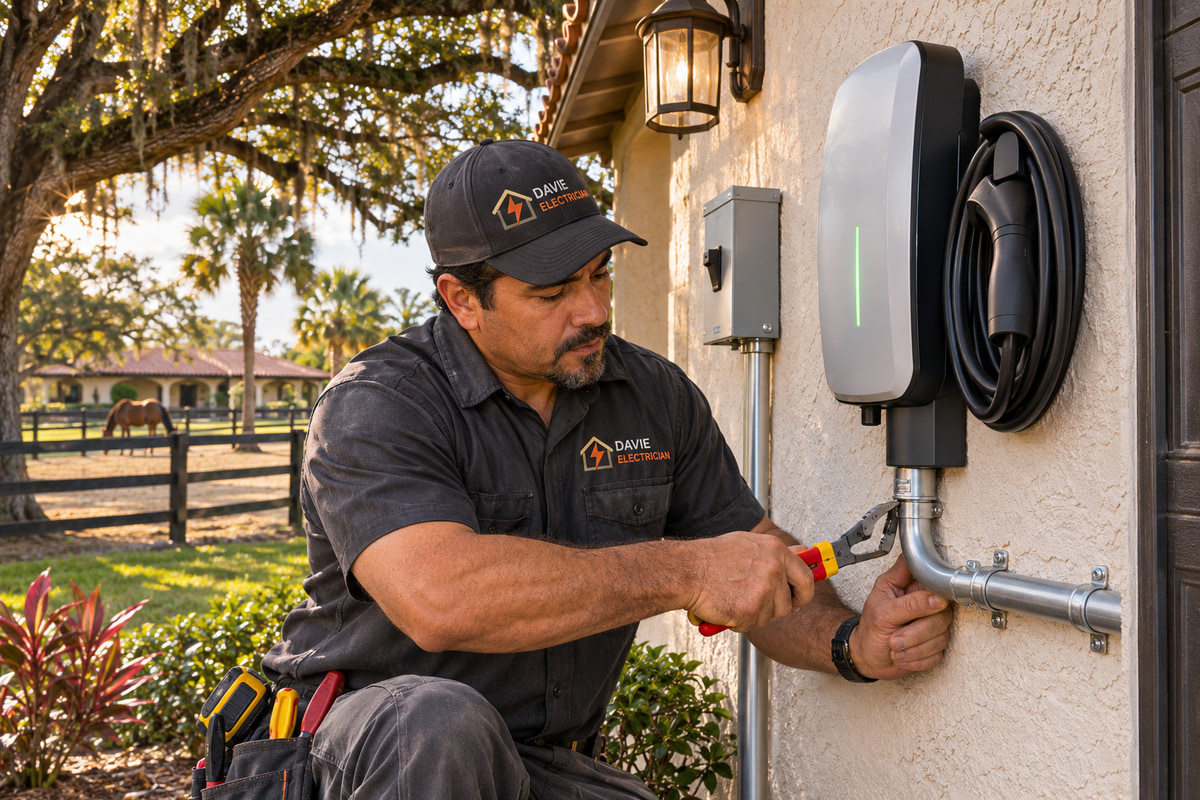
Shared buildings, shared questions: where your responsibility starts
A detached house is simple to reason about. Everything inside the property line is yours, and everything outside is the utility's. Condominium and villa style living along the Pine Island Road corridor of Davie adds a middle layer. Some systems are yours, some belong to the association, and some are shared among neighbors. Knowing where the line falls is the first step in any electrical conversation, because it determines who can authorize work, who pays for it and who is allowed to open which box.
As a general rule, equipment that serves only your unit is more likely to be yours, while equipment that serves multiple units or the building as a whole is more likely to be the association's. Your own panel, the circuits beyond it, the outlets, switches and fixtures inside your walls, and the appliances and fans you installed typically belong to you. The service from the utility, the meter bank, main distribution equipment, lighting in stairwells and hallways, exterior building lights and wiring in common walls generally belong to the association. The details can vary, and your governing documents are the authority. If you are unsure, read them or ask your management office before work begins.
The practical consequence is that a problem can sit on either side of the line and look the same from your kitchen. If the power to your unit goes out, is it a tripped breaker in your panel, a problem at the meter bank, or an issue with the building feed? A good first step is to check your own panel and your ground fault devices. If your panel has power but nothing inside works, the issue is inside the unit. If your panel is dead, the issue is upstream, and you will need the association or the utility. Neighbors can help: if they have power and you do not, it points to your unit.
Another feature of community living is that some shared elements are hidden. A wall between two units may carry wiring for both. A breaker in your panel might feed a light in a shared hallway by historical accident. Such cross connections are uncommon but real, and they surface when someone starts a remodel. Tracing circuits before opening a wall is part of safe work.
We always begin with a phone conversation, in which you describe your unit, the issue and what you know about your association. A visit follows if the job needs one. Where association approval is required for work in your unit, we encourage you to obtain it before scheduling, so the work can proceed without delay and without dispute afterward.
Inside your unit: the panel, the circuits and what the layout tells you
Most units have a small panel, often located in a closet, hallway, laundry nook or garage. It tends to be smaller than a panel in a large house, because the unit has fewer circuits. Smaller does not mean simpler. The same principles apply: every circuit has a breaker sized for its wire, every breaker should be labeled, and the panel should have working space in front of it that is not blocked by shelves, boxes or hanging clothes.
Start by reading your panel. Open the door and look at the labels. Do they match what you find in your home? If a label says kitchen but the breaker also controls a bedroom, the label is wrong, and wrong labels lead to mistakes during repairs. Relabel carefully, or have an electrician do it as part of a visit. Look for any breaker that is warm, discolored or noisy. Look for double tapped breakers, where two wires share a single terminal not designed for it. Look for signs of moisture, rust or insect nests. These are quick observations and can be done without touching anything inside the panel. Do not remove the inner cover yourself.
Next, think about load. A compact unit can still have a heavy load: a modern air conditioner, an electric range or cooktop, a dryer, a dishwasher, a microwave and a lot of electronics. The service to the unit has a fixed capacity, and the panel may have little room for additions. If you are planning to add anything significant, such as an induction cooktop or a larger air conditioner, talk first. A load review shows whether the existing service can handle it, and if not, what options exist. Sometimes the answer involves the association because the unit's service is limited by the building's equipment.
Look also at your protective devices. Kitchens, bathrooms, laundry areas and outdoor spaces should have ground fault protection. Bedrooms and living spaces in many homes benefit from arc fault protection. Whether yours does depends on the age of the unit and the rules in effect when it was wired or last updated. Adding protection to an older circuit is often possible with a combination breaker or protective outlet. The test button on each device is your friend.
Consider a worked example. An owner wants to replace an old electric stove with a newer model that comes with a convection oven and a larger rating. The cord on the old stove was a short, thick one, and the receptacle in the wall is a particular type. The new stove might need a different receptacle or a different cord, and the wire behind the wall must be heavy enough for the new rating. The breaker in the panel must match the wire, not the appliance's wish. If the wire is undersized, the answer is either a smaller appliance setting where the maker allows it, or a new run of wire from the panel. In a unit with finished walls and shared ceilings, a new run is more involved than in a single story house, and it may need association approval. Looking at these facts before buying the appliance saves a return trip to the store.
Another common unit project is the home office. Two monitors, a computer, a printer, a lamp, a space heater in the cold months and a phone charger can all land on the same bedroom circuit, which may also carry the bedroom lights and a television. Adding a power strip does not add capacity. If breakers trip or lights dim when the heater runs, the better fix is a dedicated circuit for the office wall, run from the panel if the building construction allows it.
Finally, smoke and carbon monoxide alarms. In multi unit buildings, these may be connected to a building system or be individual units in each home. Know which you have, test them, and ask your association about the rules. A working alarm in your unit protects your neighbors too.
Association rules, approvals and doing the paperwork in the right order
For many owners, the surprising part of electrical work in a community is the paperwork. Associations commonly have rules about alterations, contractors, working hours, insurance requirements for those working on the property, elevator or parking use, and the handling of waste. These rules exist to protect the building and the neighbors, and they are easier to follow than to argue about.
The best approach is to ask before you schedule. Contact your management office or board and describe the work. Ask whether approval is needed, what forms are required, what the notice period is, and whether there are limits on days and hours. Ask whether the association requires anything from the contractor, such as proof of coverage. We can help you describe the work in clear terms for the form, but the decisions belong to your association. If your project involves shared elements, such as exterior walls, roofs, shared conduits or common panels, the association may need to perform or approve the work itself.
Permits are another layer. Local authorities decide which electrical work needs a permit. Typical examples include new circuits, panel replacements and service changes. A permit applies to the work, and an inspection follows. Associations sometimes ask for a copy of the permit and inspection result for their records. It is worth requesting copies and keeping them with your unit's documents, since they also help when you sell or insure your home.
Timing and noise matter in close quarters. Drilling, cutting and moving materials can disturb neighbors, and associations often limit work hours. Power shutdowns can affect neighbors if the work involves shared equipment, and notice is usually required. Planning the work so that it is quick and tidy is a courtesy that earns goodwill. Protecting common areas such as hallways and elevators with coverings, and cleaning up after, is also expected.
One last point: be honest and complete when describing the work. If you leave out a detail, such as a new circuit that will tie into a shared panel, the project may be halted later. Providing a clear description at the start avoids complaints.
Insurance is a related topic. Many owners carry a policy for the inside of the unit, while the association carries coverage for the building. The line between the two follows the same lines as the equipment. When an electrical problem damages something, the question of which policy responds often depends on where the fault began. That is a conversation for your insurer and your association, but it explains why records of who did what, and when, are valuable. A note stating that the panel was inspected, that protective devices were tested and that wiring was done under a permit supports your position if you ever need to make a claim.
It is also wise to ask about restrictions on certain equipment. Some communities limit electric vehicle charging in shared garages, require approval for large air conditioning changes or prohibit certain exterior fixtures. Asking before you buy avoids the frustration of owning something you cannot install.
Many associations also keep a list of past projects, and a neighbor who has recently done similar work can be a good source of practical advice about the approval process. Ask around, and take notes. We prefer to hear the full picture on the phone, so we can advise on what to ask for and what to expect.
Patios, lanais, entry lights and the shared outdoors
Even in a community setting, much of daily life happens outdoors. A screened patio or lanai, a front entry with a light, a balcony or a garage all contain electrical devices exposed to humidity, rain and sun. They are your devices in many cases, but they sit on a building shared with others, so the rules may differ from those of a single family house.
Fixtures on patios and entries should be rated for damp or wet locations. Over time, gaskets dry and crack, screws rust and insects enter. A fixture that lets water in will eventually fail and may trip a ground fault device. Replace tired fixtures with ones that match the building's style, and check your association rules about exterior appearance first. Many communities specify fixture styles and bulb colors, and replacements should follow them.
Ceiling fans on lanais are popular for comfort. They must be rated for damp or wet use and mounted securely to a box designed to carry a fan. Wobbling is a symptom of a loose mount, an unbalanced blade or a worn motor. If a fan wobbles, turn it off and look into it. An improperly supported fan can fall. Wiring for fans should include a switch location that you can reach easily, and a separate control for light and fan is more convenient than pull chains.
Outlets outdoors should be protected by ground fault devices and have in use covers that close over a plugged in cord. If your outlet has a flat cover that only protects it when empty, plugging in a cord leaves it exposed to rain. Replace it with a bubble style in use cover. In a community setting, you may need approval to alter the exterior, and some associations specify which style they allow.
Also consider common area lights. If a pathway light is out or an entry light flickers, report it to the association rather than attempting a repair yourself. Those fixtures often are on association circuits, and tampering with them can create liability. Reporting promptly helps everyone stay safe, especially at night when slips and trips are more likely. If a light in a shared place is hot, buzzing or sparking, tell management right away.
Noise, nuisance trips and what neighbors can tell you
Close quarters make some electrical symptoms easier to compare. If your breaker trips often, ask a neighbor in a similar unit whether theirs does too. If a hum is coming from a wall, check whether it is heard next door as well. A shared symptom points toward shared equipment, and an isolated symptom points toward your own wiring.
Buzzing, humming or crackling are sounds that deserve attention. A light dimmer may hum mildly if it is loaded near its limit, which is usually harmless but can be improved by choosing a better matched dimmer. A buzzing breaker, a crackling outlet or a hum inside a wall is different. Those can mean loose connections or arcing, which produce heat. If you hear them, stop using that circuit and call.
Nuisance trips come from a few usual causes. Overloaded circuits trip when too many devices run together, especially in kitchens where a toaster, microwave and coffee maker may share a circuit. Ground fault devices trip when current leaks, often from moisture or a failing appliance. Arc fault devices trip when they sense a pattern of sparking, sometimes caused by a loose plug, a worn cord or a motor with brushes, such as a vacuum cleaner. Determining which type of device tripped, and when, is a big part of finding the cause. Keep notes: what was running, what the weather was like, whether the trip was immediate or delayed.
Another condition common in multi unit buildings is flickering that follows other activity. If your lights dim when a neighbor's air conditioner starts, the shared supply may be strained, or a connection in the shared equipment may be loose. That is a matter to bring to the association and the utility. If your lights flicker only when your own equipment starts, the problem is inside the unit.
Sound can also travel. A fan or fixture installed on a shared wall can transmit vibrations to a neighbor's unit. A transformer or a power supply that hums can annoy people on the other side of the wall. Mounting devices on resilient bases and choosing quiet equipment helps. These are small acts of courtesy that make community living pleasant.
A smooth service visit in a community setting
A little preparation makes a visit to a condominium or villa smoother. First, confirm the approvals. Second, tell us about parking, gate access and any check in process. Some communities require visitors to be registered, and a contractor waiting at the gate is a waste of everyone's time. Third, clear the work area. Move furniture away from the panel, off the wall where work will occur and out of the way. Fourth, note any shutoffs that will affect neighbors, and give them notice if needed.
During the visit, the electrician will start by listening to your description and looking at the area. The panel is usually inspected first, followed by the circuits involved. Measurements confirm what the eye cannot. You will be told what was found, what the options are and what each involves. For small repairs, many can be completed on the spot. For larger work, you will receive a clear scope, and a time to return. We do not promise prices in advance of seeing the job, and we do not guess about work we have not examined.
After the work, the electrician should test the circuits, restore the area and explain what was done. Ask for any notes you need for the association or the permit. Keep a record of the date, the work performed and the devices installed. If an inspection is required, it will follow, and you may need to be present or arrange access.
Maintenance is simple but valuable. Test ground fault and arc fault devices monthly. Keep the panel clear. Replace worn cords. Do not overload power strips. Report common area issues to the association. After storms, check outlets near windows and doors for signs of water. After power outages, wait a moment before turning on all appliances at once, to avoid surges.
For anyone who lives in a community like Pine Island Ridge, good electrical care combines personal diligence with cooperation. Know your boundaries, follow your rules, and keep good records. When you need help, call and describe what is happening. A quote follows the conversation, and any job that is more than a simple fix begins with a visit. That is how we keep things straightforward, fair and safe for you and your neighbors.
Settings in the Pine Island Ridge area
- The Pine Island Road corridor: a busy road with community style housing set back from it.
- Villa and condominium buildings: shared walls, meter banks and association managed common areas.
- Screened patios and lanais: damp locations with fans, lights and outlets.
- Garages and utility closets: where unit panels and appliance circuits are often found.
Nearby communities
Forest Ridge lies close by, with single family homes and pools, and Rolling Hills offers a golf oriented setting. Each has its own page. The main Davie page provides the wider picture.