

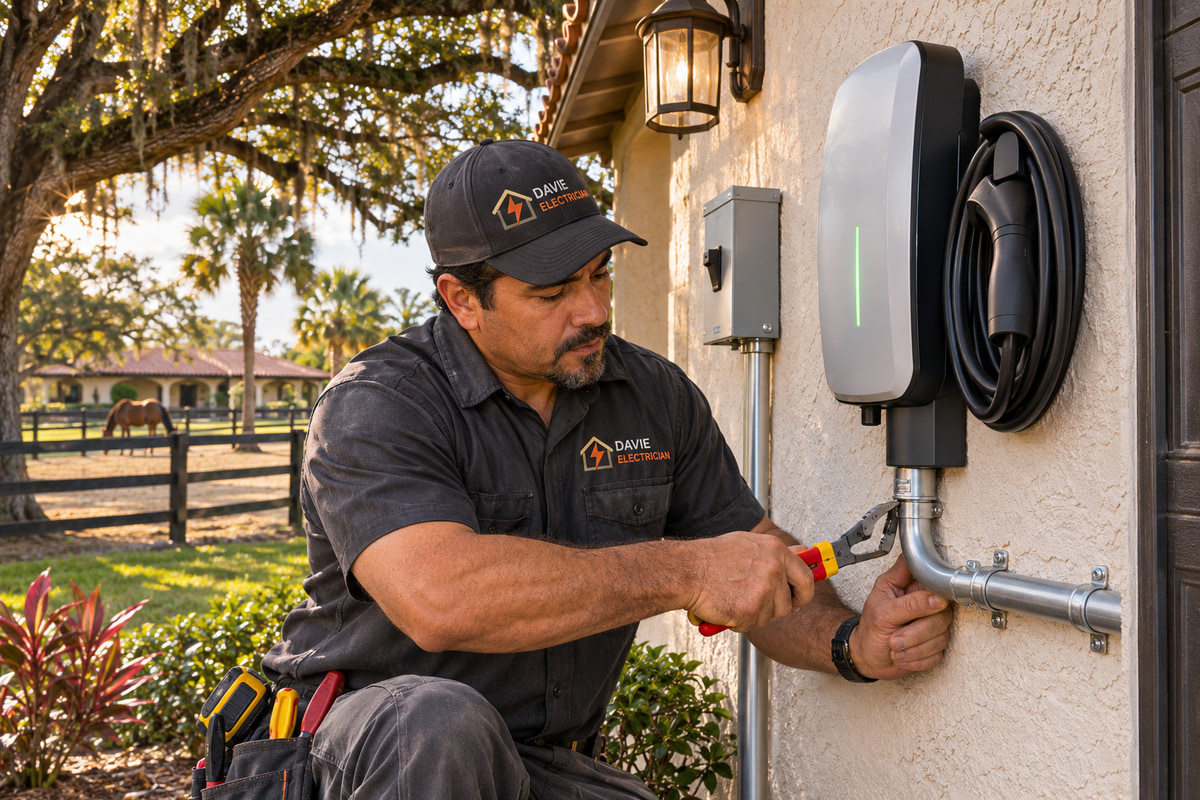
The Town We Work In
Davie does not look like most of South Florida. Drive west from the coast and the grid of identical subdivisions loosens up. Fences get longer, driveways turn into lanes, and paddocks appear behind ordinary looking houses. Orange Drive is known for horse properties, the Bergeron Rodeo Grounds speak to the western heritage of the town, and the storefronts around the town center carry a ranch style look that sets Davie apart from its neighbors. Within a few minutes you can pass a barn, a golf community, a university campus and a busy plaza.
That variety is exactly what shapes our business. An electrician who only works on tract houses will meet a surprise the first time a customer asks about power for a stable or lights for a riding ring. An electrician who only works in commercial buildings may not think about the main house, the pool and the screened enclosure sharing one service. We take the whole mixed picture as normal, because in Davie it is normal.
The housing itself comes in layers. Some homes near the older core around Davie Road were built long before air conditioning was standard, and have been added to again and again. Concrete block ranch houses are common across Broward County, and they hide their wiring in ways that frame houses do not, so even a simple change can mean thinking about conduit routes and surface runs. Golf communities such as Rolling Hills and Arrowhead have established homes with mature landscaping, many with pools. Newer subdivisions toward the western edge, near Flamingo Road, bring higher demand circuits, vaulted ceilings, planned landscape lighting and questions about chargers.
Then there is the land. Larger lots mean longer distances, and distance is the quiet enemy of good electrical work. A barn sitting a long way from the house needs a feeder sized for the run so the lights do not dim when a fan or a compressor starts. A gate at the end of a driveway needs both power and control wiring, protected from moisture and from the lawn crew. Irrigation pumps, arena lights and well equipment all want circuits that suit them rather than an extension cord strung across the yard.
Weather matters as much as distance. South Florida summers bring regular thunderstorms, and open acreage is exposed to lightning in a way that a lot surrounded by tall houses is not. Humidity gets into boxes and fittings. Rain finds every outdoor outlet that was installed without a proper cover. Hurricane season brings outages and the sudden interest in generators and transfer switches that follows each storm. We plan with these conditions in mind, which is why the guides on this website spend so much time on moisture, surge protection and storm preparation.
The commercial side of Davie has its own character. University Drive, State Road 84, Griffin Road and Davie Road carry plazas, offices, medical buildings, warehouses and small shops. Tenants change, and every new tenant wants lighting, outlets, signage and sometimes a larger panel in a space that was wired for someone else. The town center adds small storefronts and restaurants, where older buildings meet modern equipment. Near the Nova Southeastern University campus, rentals and small businesses share the same streets, and student housing raises its own questions about outlets, cords and shared circuits.
Knowing a place does not mean pretending to know your building before we see it. It means arriving with sensible questions. How old is the panel? Is there a subpanel in the barn? Where does the pool equipment connect? Who manages the plaza, and what do they require? Those questions come from living with the same kinds of properties day after day, and they save time for everyone.
It also means being straightforward about neighbors. Our work reaches past the town limits into Cooper City, Plantation, Southwest Ranches, Weston and other Broward communities, and the area pages on this site describe each of them on their own terms. A home in Embassy Lakes has different needs from a ranch lot in Southwest Ranches, and a shop on Las Olas has different needs from a villa in Tamarac. We try to write and work accordingly instead of treating the county as one flat map.
Seasons shape the calendar here, too. In the heat of summer, air conditioners run for long stretches and weak connections show themselves as flickering lights, warm breaker panels and tripping mains. The rainy months expose outdoor outlets, pool lighting and barn fixtures that were never sealed well. Late in the year, many owners think about holiday lighting and the cords that go with it. Hurricane season sits across all of this, with the usual scramble for generators, surge protection and a safe plan for the panel when a storm is forecast. Our guides follow that rhythm so a reader can find what matters at the time of year it matters most.
Equestrian property deserves its own mention. A barn is not just a garage with stalls. Hay and bedding create dust, hoses create damp, animals chew and kick, and rodents love the warm hidden spaces around wiring. Fixtures that suit a living room can fail quickly in a stable aisle. Cable that looks fine in a workshop can be damaged by a curious animal. We plan barn circuits with those habits in mind, using protection and enclosures meant for the conditions and keeping switches, outlets and fans where people can use them safely, including at night when the lighting is all you have.
Workshops and hobby buildings bring a different set of loads. A table saw, a welder, a compressor, a kiln or a shop vacuum each pulls current differently, and several running at once can overwhelm a circuit that was sized for a few lights. Owners of larger lots often build such spaces gradually, adding a machine here and an outlet there, and the wiring ends up carrying more than anyone intended. Looking at the whole picture before adding the next machine is usually cheaper and safer than fixing a failure afterward.
Pool homes are everywhere in Davie, and the equipment around a pool is a small electrical system of its own. A pump, a heater, a light, a cleaner, a spa blower and sometimes an outdoor kitchen or a fire feature all connect to the house through circuits that must be protected and bonded with care. Water changes the stakes, which is why we treat pool and spa work as a separate discipline rather than just another outdoor outlet.
Finally, it means remembering that behind every call is a person with a real problem. A family wants the lights to stop flickering. A horse owner wants the barn to be safe at night. A shop owner wants the doors open on time. Our job is to turn those wishes into sound wiring that works quietly for a long time.
How We Approach a Job
Every job begins with listening. A caller who says the breaker keeps tripping may be describing an overloaded circuit, a failing appliance, a damp fixture or a loose connection, and the first few questions often narrow it down. What was running when it tripped? Does it happen in the afternoon heat or after rain? Is it one breaker or several? We would rather ask a few more questions than guess and replace parts that were never the problem.
Next comes looking. For small repairs, that may be a careful test of the device and the circuit. For anything bigger, it is a visit to the property, where we look at the panel, the service, the grounding, the condition of the wiring we can see and the way loads are arranged. A visit is the only honest basis for a quote on a panel upgrade, a rewiring plan, a barn feeder, a pool circuit or a commercial buildout. Numbers given before that point are guesses, and we try not to hand out guesses as promises.
After the visit, we explain. This is the part we care about most. A good explanation names the problem, shows where it lives, describes the options and says plainly what each one involves. If a panel can stay with a few corrections, we say so. If an old branch circuit has loose connections that justify replacement, we say that too and explain the reasoning. Some people want the short version and some want every detail, and we adjust to whichever you prefer.
Planning follows. On larger properties, planning is a big part of the work. A feeder to a barn needs a route that avoids drainage, tree roots, fences, irrigation lines and the places a horse trailer turns. Conduit has to be buried or mounted in a way that suits the soil and the weather. A subpanel needs a location that is dry, reachable and sensible for whoever uses the building. Lighting in a stable or workshop must withstand dust and damp, and switches need to sit where a person with full hands can reach them. We think through these points before digging, not during.
For older houses, planning means respect for the people living there. A staged rewiring can move through the house room by room so that the kitchen, the bedrooms and the refrigerator are not all dark at once. We discuss which walls will be opened, which can be fished from the attic or crawl access, and how patching will be handled so you are not surprised later. In concrete block homes, we weigh hidden routes against surface conduit and describe the tradeoffs honestly, including how each choice looks once it is finished.
For commercial spaces, planning means working with the building. A property manager may have rules about work hours, panel access, fire alarm coordination or contractor paperwork. A tenant may have an opening date. We ask early so the electrical work fits around the other trades, and so the lighting, outlets and panel capacity match the way the space will really be used rather than the way it was used by the last tenant.
Safety shapes every choice. Wet areas such as pools, spas, outdoor kitchens, barn wash racks and lanais call for ground fault protection and careful bonding. Outdoor fixtures need weather rated boxes and covers. Panels need room, labels and clear access. Smoke and carbon monoxide alarms deserve attention whenever walls are open. When a question turns on the electrical code or local permit rules, we encourage owners to confirm the details with a licensed professional or the city permit office, because rules and requirements vary by project and change over time. We do the work with care, and we do not ask you to take shortcuts.
Scheduling is part of planning, and we try to be realistic about it. Some jobs fit into a single visit, and others need several: one to look, one to run the main work and one to finish and test. Jobs that involve an inspection or a utility connection depend on other people, and we explain where those dependencies sit so that you are not left guessing. When a material has to be ordered, or a trench has to wait for dry ground after heavy rain, we say so and give you our honest expectation instead of a hopeful date.
Documentation matters too. A well labeled panel is a gift to the next person who opens it, whether that is you, a future owner or another electrician. We label breakers clearly, note where subpanels and disconnects are, and explain which circuit serves which building or piece of equipment. On acreage, where a barn, a pool and a gate may all hang from different feeders, knowing where each one lives can save a lot of confusion in an emergency.
Honesty also covers what we decline to do. If a job is better handled by another trade, such as a roofer for a leaking penetration or an appliance technician for a failing motor, we say so. If an upgrade is not needed, we do not sell it. If a repair will only hold for a short time, we say that clearly and talk about the proper fix, so nobody walks away thinking a temporary measure is a permanent cure.
Testing closes the loop. When the work is done we test circuits, protective devices, switches and fixtures, label what needs labeling, and walk the owner through what changed. We clean up, protect finished surfaces while we work, and leave the property in a condition you can use right away. If a follow up question comes later, you can call and talk it over with the people who did the work.
Finally, we keep learning from each property. A strange problem in a barn teaches something about moisture and rodents. A tricky buildout teaches something about managers and schedules. We take those lessons into the next job and into the guides on this website, which is why many of those articles read like conversations about real situations rather than generic lists.
What Working With Us Is Like
Contact starts simply. Call and describe the situation, or use the form on the contact page. Tell us where the property is, what kind of building it is and what you have noticed. We will ask a few questions, give you early thoughts, and tell you whether the job can be quoted by phone or needs a visit. If you are in the middle of a problem, we will also tell you what to switch off and what to leave alone until we arrive.
We try to keep communication plain. Electrical work is full of jargon, and nothing is gained by hiding behind it. If we say a breaker is mismatched, we will explain what that means. If we recommend a transfer switch, we will describe what it does during an outage and what it does not do. You should always know what you are paying for and why.
Quotes are given by phone for straightforward tasks, such as replacing a fixture, adding an outlet or installing a ceiling fan. Larger work, including panels, rewiring, barn and pool circuits, generators, chargers and commercial buildouts, starts with a visit. That is not a way to delay. It is a way to protect you from a number that falls apart once the walls are open or the trench is dug. We do not promise prices before we have seen the property.
Homeowners can expect us to treat the house as a home. That means covering floors where needed, keeping tools tidy, closing doors on pets and asking before shutting off power for long stretches. If the work will leave you without a circuit for part of a day, we say so in advance and plan around meals, work calls and the needs of anyone in the household who relies on equipment.
Ranch and acreage owners can expect us to treat the land with the same care. Gates stay closed when animals are loose. Trench routes are discussed with the person who knows the property best. We pay attention to where horses stand, where feed is stored and where dust collects, because those details decide what kind of fixture and enclosure make sense. If a job involves digging near irrigation, drainage or fencing, we raise it before the shovel goes in.
Business owners can expect us to respect the clock. Retail and office spaces cannot stay dark for long, and restaurants and clinics have equipment that needs steady power. We ask about opening dates, deliveries and the neighbors in the plaza, and we plan work so that disruption is limited. If a landlord or property manager needs information about the work, we are glad to coordinate.
For emergencies, expect calm. A sudden outage, a burning smell, a main breaker that will not stay on or a storm damaged service all feel urgent, and they are. We will talk you through immediate safety first. If there is smoke, fire or a person in danger, call emergency services before anything else. Once the situation is safe, we work on a temporary measure if one makes sense, and then a permanent repair that deals with the cause. We do not promise arrival times, because storms and traffic make such promises unreliable, but we do promise to be clear with you about what is happening.
After the job, we stand behind the work in the practical sense that matters: you can call and ask questions. If something does not seem right, we want to hear about it. If you only need a quick explanation of how a new subpanel is labeled or how a transfer switch is meant to be used, we are happy to go over it again.
We also hope this website is useful even if you never call. The service pages explain how each kind of work is planned. The area pages describe what is distinctive about neighborhoods and corridors in and around Davie. The guides cover problems, buying advice, storm preparation, safe habits and home types, written to help you make a good decision whether or not you hire anyone. Where a topic touches the electrical code or permit rules, the guides point you toward a licensed professional or the city permit office instead of pretending to give legal answers.
Some customers ask how to prepare for a visit. A few simple steps help. Make sure we can reach the panel, and clear a path if it sits in a crowded garage or utility room. Know where the main shutoff is, and if a barn or workshop has its own subpanel, tell us where it is. Write down what you have noticed, even small things like a faint buzz or a warm cover plate, because small clues often point to the cause. Keep pets and animals secured, and let us know about any gates, codes or neighbors we should be aware of when we arrive.
Others ask how to judge whether a recommendation makes sense. Ask what the problem is, where it is, what the options are and what happens if you wait. A sound answer is specific. It names the circuit, the device or the connection, and explains why it matters. Be cautious of vague warnings that offer no detail, and equally cautious of reassurance that does not explain why something is safe. A good contractor welcomes questions and answers them without hurry.
Finally, we know that choosing an electrician is a matter of trust. We cannot ask you to take that on faith, so we try to earn it in small ways: by answering the phone, by explaining before we begin, by telling the truth about what we find and by leaving the property cleaner than we found it. That is the standard we set for ourselves in Davie and the neighboring towns we serve.
If you take one thing from this page, let it be this: good electrical work is mostly calm, careful and unremarkable. Lights come on, the pump runs, the gate opens, the shop stays open. When we have done our job well, you stop thinking about the wiring altogether. Reach out when you are ready, tell us about your property, and we will talk through what makes sense.