

A town made of several different kinds of property
Ask a few people what Davie is and you will hear different answers. Some will describe the western themed Davie Town Center with its wooden storefront look. Others will talk about the rural and equestrian properties on larger lots where horses, barns and workshops are part of daily life. Others still will point to the Nova Southeastern University campus, the shopping plazas along University Drive and Flamingo Road, or the suburban streets of pool homes and screened patios. All of them are correct, and all of them are Davie.
For an electrician, that variety is the interesting part. A service call in a subdivision may involve a breaker panel in a garage and a pool equipment pad behind a lanai. A service call on acreage may involve a long feeder run to a barn, a pump house and a gate. A call in a small shop near the town center may involve a tenant space with its own meter and a landlord's wiring that nobody has mapped. Each setting has its own habits, its own typical problems and its own questions to ask before the work begins.
Because of this, a single list of services does not describe what we do here. The way to think about it is to start with the property. How old is it? How large is the lot? Where does power come from and where does it go? What has been added over the years without anyone updating the panel directory? These questions apply on every street in town, but the answers vary enormously from one address to the next.
This page is a general introduction to the whole of Davie. Separate pages on this site go deeper into particular parts of town, including Old Davie, the town center, Rolling Hills, Pine Island Ridge, Forest Ridge, Shenandoah, Westridge, Arrowhead, the Nova Southeastern University area and the main roads that run through it. If you know which part of town you are in, those pages will be the more specific read. If you are not sure, or your property sits between categories, keep reading here.
One more point belongs at the start. Everything here is general education about how electrical systems behave in this setting. It is not a substitute for a look at your actual wiring, and it does not promise any particular price, schedule or result. A quote comes after a conversation on the phone, and any job that is more than a simple repair needs a visit to your property first so that the work is planned around what is really there.
Subdivision homes: panels, pool equipment and the quiet aging of a house
Much of Davie's housing sits in planned residential communities, many of them with pools, screened enclosures and attached garages. These houses were mostly built in a handful of waves, and the era of construction tells you a great deal about the wiring behind the walls. Homes from earlier decades tend to have smaller electrical services, fewer circuits and fewer outlets than modern living demands. Newer homes have larger services and more circuits, but they also carry more electronics, more air conditioning capacity and more demand on every circuit.
The first thing worth knowing about any house is what its panel looks like. Is it clean inside? Are the breakers labeled? Is there rust or discoloration near the bottom, which can come from moisture getting into the enclosure? Is the panel in the garage, where it shares space with stored paint and lawn equipment? These are quick observations that tell an electrician how well the house has been looked after. A panel that is warm, buzzing or smelling of heat deserves attention at once, and our page on breakers that keep tripping explains what that behavior is trying to say.
Pool homes add a layer of electrical equipment that the house itself does not need. A pump, possibly a heater, a light, a salt system, a control panel and a bonding network all live outdoors. They operate in a wet environment, and the wiring must be built and protected accordingly. Pool lights that trip a breaker, pumps that run hot, and corroded connections at the equipment pad are everyday calls in this area. The pool and spa electrical page goes into the rules and the typical causes.
Screened enclosures and lanais are another feature. Ceiling fans, outlets and lights on a covered patio live in a damp environment even when they do not look it. Fixtures need wet or damp ratings, and outlets need the right cover and protection. Over time the gaskets dry out, the screws corrode, and moisture finds its way into the box. A fixture that was perfectly adequate at installation can become a problem fifteen years later.
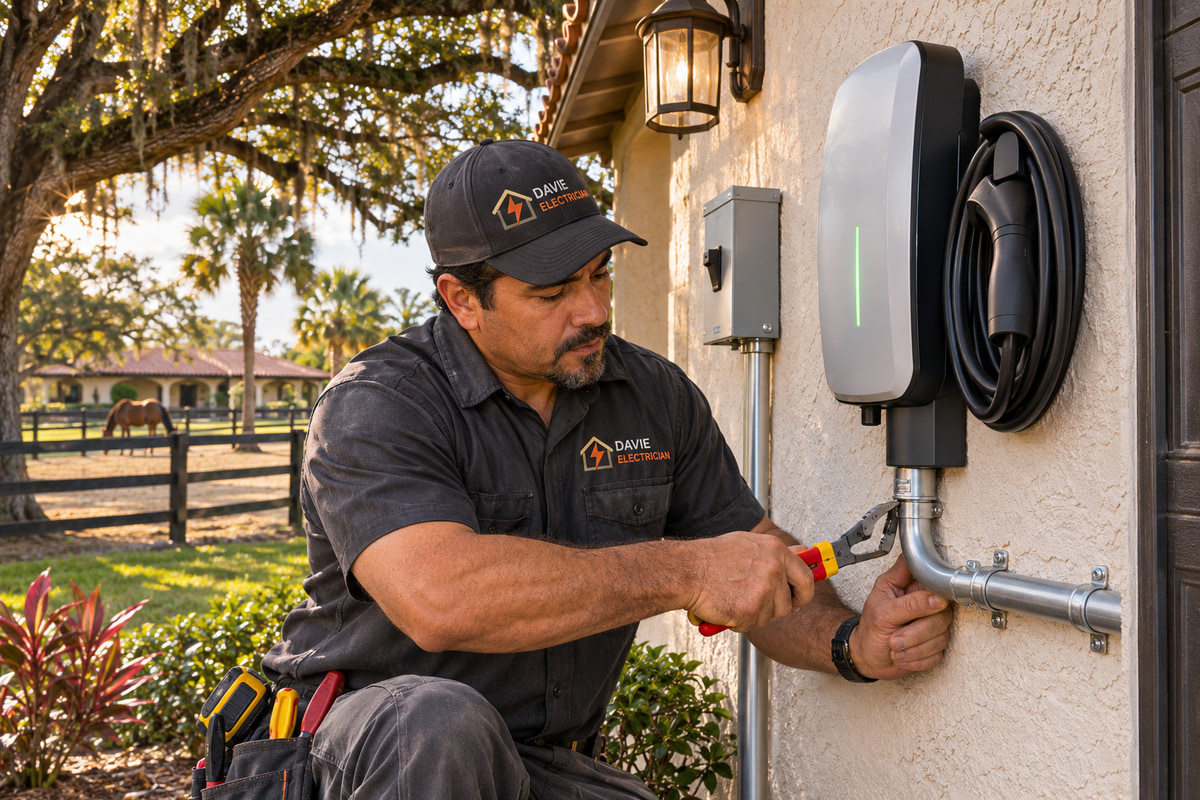
Then there are the additions people make once they have lived in a house for a while. A larger air conditioner, a second refrigerator in the garage, a home office, a workshop corner, an electric vehicle charger. Each puts a new demand on a system that was designed for a different household. Adding them one at a time without looking at the total is how panels become crowded and breakers start to trip at odd moments. A good electrician looks at the sum before adding the next piece.
Acreage, barns and equestrian land: where electricity has to travel
The western part of Davie is known for rural and equestrian properties, and this is where electrical work looks most different from a typical suburb. A property with a few acres might have a main house, a guest cottage, a barn with stalls, a tack room, a workshop, a pump house, a gated entry and lighting along a long drive. Each of those structures needs power, and the wiring between them is the real challenge.
The central idea is that every building should be fed by a properly sized and protected feeder, usually ending in a subpanel at the building. That keeps the barn on its own set of breakers, makes it easier to shut off power in an emergency, and avoids long, undersized branch circuits trailing across the yard. It also means a fault at the barn does not drop the house. Many older rural setups grew without that discipline, with extension cords, spliced wires and shared circuits stretched across fields. Cleaning that up is often the most valuable thing an electrician can do for a property owner.
Barns carry particular hazards. Hay dust, shavings and cobwebs are fuel for a spark. Horses chew wood, wires and anything within reach. Moisture and ammonia from stalls corrode metal. Rodents nest in warm corners. The right response is wiring in conduit, sealed fixtures, covers on every box, ground fault protection where moisture is present, and fixtures positioned out of reach of animals. Our pages on barn and workshop electrical, on rodent damage to wiring and on gate and irrigation controls explain these points one at a time.
Fans deserve their own mention in a barn. Stall fans move air across animals in the heat, and they often run for long hours. A fan that hums, runs hot or trips its breaker is a sign of a failing motor or a tired connection. Because the fan sits in dusty air, the motor shell and the wire at its back should be wiped clear regularly with the power off at the breaker. A well kept fan circuit is a small piece of animal care as well as electrical care.
Water also plays a major part on acreage. Livestock waterers, pumps for irrigation and shallow wells all draw electricity in wet places. A heater in a trough, a pump in a pit or a fan over a stall must be protected against faults. A small leak of current into water can harm an animal long before it harms a person. Regular testing of ground fault devices and visual checks of cords and connections protect everyone.
Standing back, the main message for acreage owners is to treat the electrical system as infrastructure, in the same way you would treat a fence line or a drainage swale. Plan it, document it and maintain it. A short sketch of what feeds what, kept in the barn office or the kitchen drawer, saves hours the day something stops working.
Heat, humidity, storms and what they do to wiring in this part of Broward County
The climate in South Florida is a constant quiet influence on every electrical system. Warm, humid air carries moisture into places where it does not belong. Outdoor equipment is rained on for months at a time. Afternoon thunderstorms in the wet season bring lightning, and lightning brings surges. Hurricane season brings the possibility of extended outages and flooding. A system that works well in a drier, cooler place might need extra care here.
Humidity speeds up corrosion. Screws, terminals, panel enclosures and metal junction boxes slowly degrade, particularly where there is salt in the air or constant dampness. Green or white crusting on a connection, rust streaks beneath a panel and pitted metal on an outdoor box are all signs that moisture has been winning. A connection that has corroded has higher resistance, and higher resistance means heat. Heat at a loose or corroded terminal is one of the commonest causes of electrical failure and, in the worst case, fire.
Heat is the other thing. Attics in this region reach very high temperatures in summer, and wiring and fixtures there live a harder life than they would up north. Air conditioners run for long hours, and their circuits carry heavy loads for far longer than the equivalent in a cooler region. Older insulation becomes brittle, and connections that were once tight can loosen from repeated heating and cooling.
Lightning and surges are a real concern. A strike near your home, or on the utility lines that serve it, can push a spike of voltage through the house. The damage is often invisible at first: a power supply that fails weeks later, a controller that behaves strangely, an appliance that dies for no reason you can see. Surge protection at the panel, combined with plug in protection for sensitive electronics, reduces the risk. The page on whole house surge protection covers it in detail.
For storms and outages, preparation matters. Know where your main breaker is and how to turn it off. Know how to shut off the pool equipment safely. If you use a portable generator, never plug it into a wall outlet to power the house, because that can send electricity back into the utility lines and endanger line workers. A properly installed transfer switch or inlet is the safe way to connect one, and it is a job for a qualified electrician with the right permit.
Businesses, shopping corridors and the campus edge
Davie also holds a lively commercial side. The western themed storefronts around the town center, the plazas that line University Drive and Flamingo Road, small offices, restaurants, salons, boarding and feed related businesses, and the activity around the Nova Southeastern University campus all create a steady demand for commercial electrical work. These jobs differ from residential ones in important ways.
First, the person who calls may not own the building. A tenant may be responsible for what is inside the space, while the landlord is responsible for the panel or the building wiring. Knowing who decides what, and who pays for what, can save a lot of confusion. Second, commercial spaces often have three phase power or larger services, and their lighting, signage and equipment are subject to different rules. Third, a business cannot always close for a day, which makes planning and scheduling more delicate. Work may need to happen early, late or in stages.
Common small business needs include adding outlets for equipment, installing new lighting, extending circuits for a new tenant layout, replacing worn out fixtures, and keeping emergency and exit lighting working. The page on exit signs and emergency lighting in businesses explains what these systems do and why they are tested. The page on tenant buildouts and retail electrical explains how a new space gets wired from bare walls to open for business.
A short example helps. A small business owner near a busy road wants to add a second register, a display refrigerator and a new sign. On paper it looks like three small additions. In practice each one wants its own circuit, the sign may need a timer or photocell, and the refrigerator should not share a circuit with anything that might trip it, because spoiled stock is an expensive way to learn about overloaded wire. Looking at the panel first, rather than the outlets, is what separates a tidy result from a string of power strips.
The same thinking applies to the campus edge, where small businesses and rental properties serve students and staff on tight schedules. A repair that is planned around busy periods causes less disruption than one that is rushed in the middle of them.
Restaurants and food related shops raise their own issues. Heavy kitchen equipment draws large currents, hoods and refrigeration run continuously, and heat and grease are tough on wiring. Salons run many small appliances at the same time, so circuits overload quietly. Offices often fail in a different way, with a dozen computers, chargers and power strips daisy chained from a few outlets, which leads to the extension cord habits discussed in one of our guides.
Wherever you operate, the principle is the same. Electrical capacity should match what the business really does. If you are adding equipment, tell us what it is and where it will go. If something has started tripping breakers or flickering lights, tell us when it started. A calm conversation up front shortens the visit and sharpens the quote.
How to work with us in Davie, from the first call to the finished job
Most jobs begin with a phone call. Describe what you see and hear: the breaker that keeps tripping, the room where the outlets stopped working, the barn light that flickers when the pump starts. Mention the type of property, whether it is a house, a barn, a shop or a unit in a plaza, and roughly how old it is. We will ask follow up questions, explain what the likely causes are, and tell you whether a visit is needed. For small, clear tasks a quote may be possible after the call. Anything larger or less certain needs a look in person, because nobody can responsibly give a number for work they have not seen.
At the visit, expect the electrician to start with the panel and the area of concern. Panels tell stories. They show how much capacity is in use, how tidy the work has been, and whether previous repairs were done carefully. From there the electrician follows the problem: testing outlets, checking connections, measuring voltage and tracing circuits. You will be told what was found in plain language, with the options laid out.
Permits and inspections are part of doing the work properly. Many jobs, such as new circuits, panel changes and service upgrades, require a permit from the local authority, and an inspection follows the work. The permit office decides what applies at your address. A permit protects you, because it means a second set of eyes looked at the installation, and it keeps your records in order when you sell the property or insure it.
To prepare, clear access to the panel and to the areas of work. Secure pets and, on acreage, animals. Write down the symptoms and when they happen. If you have old paperwork, such as a prior inspection report or a sketch of the wiring, set it out. If you rent, tell your landlord or property manager what is happening, since some work needs their consent.
Afterward, you should understand what was done, what to watch for, and what else, if anything, deserves attention in the future. Keep the paperwork. Test your ground fault and arc fault devices on a regular schedule. If something behaves strangely again, call early rather than late. Electrical problems rarely fix themselves, and the cost of waiting is usually higher than the cost of a short conversation.
Parts of Davie we pay attention to
- Old Davie: the historic core with older cottages and ranch style homes, where panel capacity, grounding and aging wiring are common questions.
- Davie Town Center: western themed storefronts and small shops with tenant electrical needs.
- Rolling Hills and Arrowhead: golf oriented residential communities with established homes and mature landscaping.
- Pine Island Ridge: a community style setting along Pine Island Road.
- Forest Ridge, Shenandoah and Westridge: single family neighborhoods with many pool homes and screened enclosures.
- The Nova Southeastern University area: homes, rentals and small businesses around the campus.
- The Flamingo Road and Griffin Road corridors: newer construction, retail plazas and equestrian properties.
Nearby communities we also serve
Davie sits beside several other Broward County communities, and the same electrical principles carry over. Our pages for neighboring places, including Coconut Creek on the list of related areas, describe how their housing and businesses differ from those of Davie. If you are close to the line between two towns, read both pages and call with your address so we can talk through what applies.