

Hawkes Bluff and the Streets Around It
Hawkes Bluff is a residential part of Davie, and like most established neighborhoods in town it is not one single thing. Within a short walk you can expect to find homes that were built at different times, by different builders, and then changed by different owners. We would rather say that plainly than pretend to know what is behind your particular walls. The first thing we do at any home here is look, ask questions and learn how that house actually behaves.
What that means for you is simple. The advice that fits your neighbor may not fit you. A house that was updated by a careful owner not long ago can have modern wiring and a sound panel. The house two doors down might still have original parts that were fine when installed and are now showing their age. Neither is unusual. Our job is to tell you which situation you are in, in plain language, and to leave decisions about what to do with you.
Neighborhoods in this part of Broward County tend to share some features. Many homes have a garage, a driveway, a patio or screened lanai, and some form of landscaping with irrigation. Many have central air conditioning, which is the largest electrical load most families run. Some have pools or spas. Lakes and canals are common in this region, and storms arrive from the afternoon thunderstorms of summer through the stronger systems of hurricane season. Each of those facts shapes the electrical system.
We are based in Davie, so a call from Hawkes Bluff is a local call in every sense. We know the town, the way its streets connect, and the general building conventions that Broward County homeowners deal with. We also know our limits. We do not claim detailed knowledge of every street or every association, and we will not quote rules we cannot confirm. Where a rule matters, we will tell you who to ask and then confirm it on site.
If you are new to the neighborhood, welcome. A good first step for any new owner is an honest look at what you bought: the panel, the outlets, the lights, the outdoor circuits and the safety devices. Our page on electrical safety checks explains what that looks like. If you have lived here a long time and things have started to act up, the same visit helps sort out what is a nuisance and what is a real concern.
Start With the Age and Type of Your Home
Electrical advice begins with when and how a home was built. Older single family houses in this area often have concrete block walls, which are strong, durable and well suited to storms, but difficult to open for new wiring. Newer homes may have more circuits, more outlets, more protective devices and wiring methods that reflect more recent safety rules. Townhomes and villas bring their own questions about shared walls and who owns what. Knowing which kind you have steers every later choice.
If your home is older, several things tend to be worth checking. Is the panel the original, and does it have room for more circuits? Do outlets in the kitchen, bathrooms and garage have ground fault protection? Are there outlets that do not hold a plug, switches that feel loose, or lights that flicker? Does the home have enough circuits for how you live now, with computers, a television in every room, and window units added over time? Those answers say a lot about the health of the system.
If your home is newer, the questions change. Are there enough outlets where you actually use them, such as along a kitchen counter or in a home office? Is the garage prepared for a car charger or a workshop? Does the home have surge protection at the panel, or only a few plug in strips? Are you getting nuisance trips from arc fault devices, which can be sensitive to some loads? Newer does not mean without problems, but the problems tend to be about capacity and layout rather than age.
For homes of any age, additions and renovations are a major source of surprises. A room built onto the back, a garage turned into an office or a kitchen opened up to a family room often changes the electrical load without anyone updating the panel. Sometimes the work was done well and permitted. Sometimes it was done quickly by a previous owner. A careful look shows which is which, and it is much better to learn that before a storm or a sale than during one.
If you are not sure what you have, that is perfectly fine. Take a look at the front of the electrical panel without opening anything, and notice whether there is a label with a date or a number, how many breakers are in it, and whether it is in a clear, dry place. Then call us. We can talk through what you see, and where a visit is needed we will plan it. Never open the panel cover yourself, because the parts inside stay live even when a breaker is off.
Panels, Breakers and Circuits That Have Reached Their Limit
The electrical panel is the heart of the home, and it is one of the first things people ask about. A panel has a total capacity, and each circuit inside it has its own limit. Over time, families add appliances, home offices, chargers, spas and extra air conditioners. If the panel was sized for an earlier way of living, it can get crowded, run warm or trip often. A larger or newer panel is sometimes the right fix, and sometimes a smaller change solves the problem.
Signs that a panel may be asking for attention include breakers that trip repeatedly, breakers that feel warm, a buzzing sound, scorch marks, a burning smell, no empty spaces left for new circuits, or a panel brand or style that insurers and inspectors have started to ask about. None of these means you must replace anything today. They do mean it is time for a qualified electrician to look, and our page on panel upgrades and replacements explains the usual steps.
A breaker that trips is a message, and the message is not always the same. It may be an overload from too much on one circuit, a short in a damaged cord or fixture, or a ground fault where current escapes toward water or a person. Resetting it again and again, or swapping in a larger breaker, hides the message and can make things dangerous. Our guide on arc faults explains one of the common reasons modern breakers trip.
Troubleshooting is a skill of patience. If lights flicker only when the air conditioner starts, that points one way. If an outlet is dead but the breaker looks fine, that points another. If half the house goes dark, that points a third way. Our page on troubleshooting and fault finding describes how we trace a problem step by step, working from the symptom to the cause rather than guessing and replacing parts until something changes.
One more point about circuits is that labels are often wrong. A panel directory written by a previous owner or a builder can be incomplete, out of date or just a guess. Part of a good visit is checking each circuit, correcting the labels and noting anything unusual. That small effort pays back every time someone needs to switch something off quickly. It also makes the next repair faster, because the person on site is not trying to decode someone else shorthand.
Afternoon Lightning, Hurricane Season and Your Electronics
South Florida has more lightning than most of the country, and it does not need to hit your house to cause damage. A strike on a nearby pole, tree or transformer sends a surge through the utility lines and into every home on the circuit. The surge can enter by the power service, by the cable line, or by a phone or data line. Electronics, air conditioner boards, pool equipment and appliance controls are common victims. The damage is often not obvious at first, and can show up as parts that fail some weeks later.
A plug in surge strip protects whatever is plugged into it, and that has real value. It does not protect the air conditioner, the pool pump, the refrigerator or the garage door opener unless they are plugged into it, and many are wired directly. A device installed at the panel protects the whole house from the service side. The two work well together, with the panel device taking the large surge and the strips catching what is left. Our page on whole house surge protection describes how this works.
Hurricane season adds a different set of concerns. Wind can bring down trees and lines. Rain can enter an outdoor outlet, a light fixture or a damaged service mast. Flooding can reach a garage, a low panel or an outdoor air conditioner base. Before a storm, take simple steps, such as bringing in portable equipment, securing outdoor items and learning where the main breaker is. After a storm, treat anything that got wet as suspect, and keep away from downed lines, which should be reported to the utility.
When power comes back after an outage, it sometimes does so unevenly, with dips, spikes and rapid on and off cycling. Sensitive equipment can be harmed. A good habit is to switch off large loads, such as the air conditioner, and unplug delicate electronics before a storm, and to wait a few minutes after power returns before turning things on gradually. If you smell burning or see sparking at any time, call 911 first, then a qualified electrician.
If you plan to run a generator or a battery during outages, it should be connected the right way. A transfer switch or approved interlock keeps your power from flowing back onto the utility lines and keeps your house wiring protected. Cords through windows and plugs into dryer outlets are not acceptable. A safe setup is not complicated, but it must be permitted and checked. We are glad to talk through your options and to confirm what your city building department requires before any work begins.
Lanais, Pools, Garages and the Electrical Load Outdoors
Outdoor living is a large part of life in Davie, and it is also where electricity and water are closest together. A screened lanai may have ceiling fans, lights, outlets and sometimes a television or a speaker system. Each of those parts is exposed to humidity, rain blown in sideways, insects and heat. Fixtures and outlets rated for damp or wet places last longer and are safer, and outlets in these spots should have ground fault protection.
Pools and spas add a bigger layer. Pump motors, lights, heaters, salt systems and automation controllers all need correct wiring, grounding and bonding. Corrosion is a concern, since pool chemicals and salt air attack metal. Our page on pool and spa electrical work covers what typically goes into a proper installation or a repair. If a breaker for pool equipment trips, or you feel a tingle near the pool or a metal rail, stop using the pool and call a qualified electrician right away.
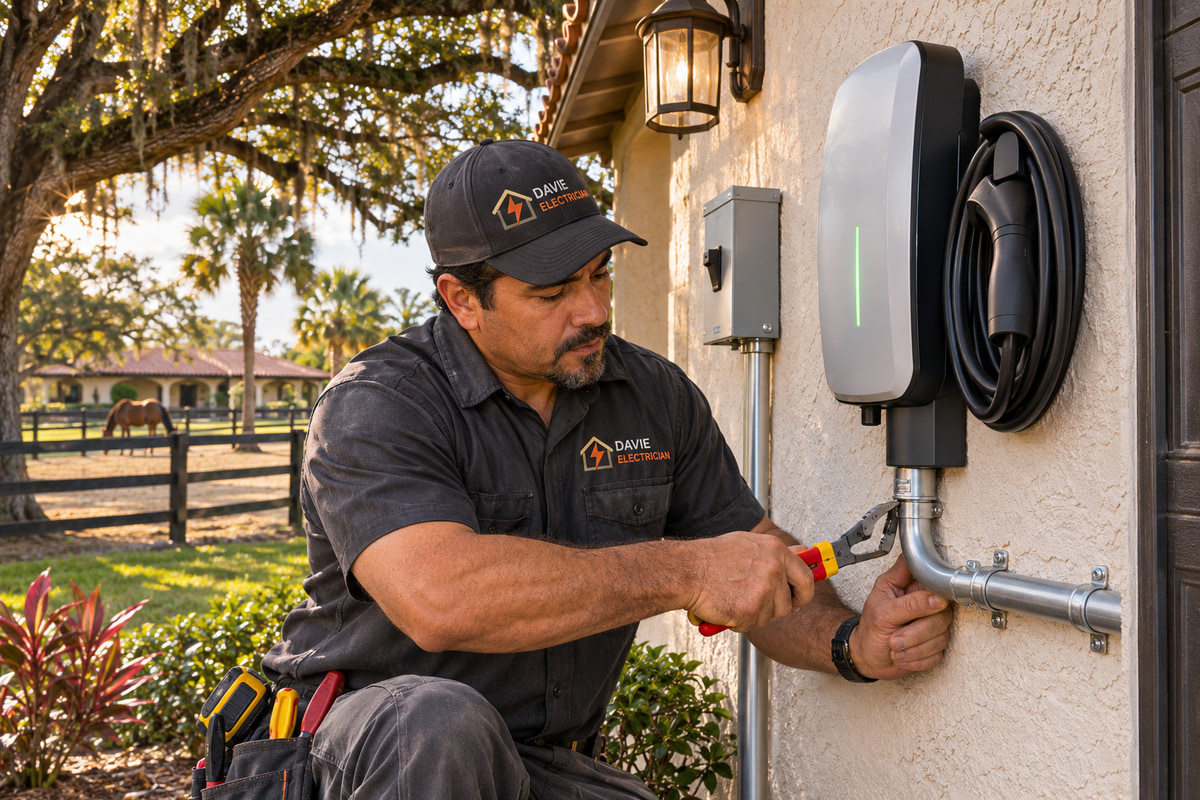
Garages work harder than they look. Many are home to a second refrigerator or freezer, a workbench, a washer and dryer, a garage door opener, lights and storage. Some are now where an electric vehicle charges, which needs its own circuit sized for continuous use. If your garage has only a couple of outlets on a shared circuit, it is easy to overload. A dedicated circuit for the freezer, one for tools and one for a charger is a sensible shape for a well planned garage.
Lights and fans deserve a word. Ceiling fans that wobble, hum or fail early are often a mounting or box problem, and a box not rated for a fan is a real hazard. Dimmers and LED bulbs sometimes disagree, causing buzzing or flicker. Landscape and security lighting benefit from correct cable, weatherproof connections and a transformer sized for the load. Our page on ceiling fans, outlets and switches explains common fixes for these everyday jobs.
Finally, think about the way your yard is used. Irrigation controllers, outdoor kitchens, string lights for parties and a gate or a motorized screen all depend on outdoor circuits. Extension cords are not a permanent answer, especially when they run across a wet lawn or through a door. A short plan, with a few properly placed weatherproof outlets, a controller on its own circuit and lights on a timer, often replaces a tangle of cords and gives you a safer and tidier yard.
Associations, Permits and Who Needs to Approve What
Many Davie neighborhoods have a homeowner association or a similar body, and some do not. If yours does, it may have rules about exterior changes, such as lighting, generators, electric vehicle chargers, outdoor equipment and visible conduit. Those rules are separate from the building code, and you may need both an association approval and a city permit. We cannot tell you what your association requires, because it varies, so ask the manager or board before work is planned.
Electrical permits and inspections go through the city building department. The general idea is that significant work, such as a panel change, a new circuit, a generator connection, a pool wiring job or a service change, needs a permit and an inspection, while some small like for like repairs may not. Rules vary and change, so the right step is to confirm on site and with the city. Our article on how electrical permits work in Florida explains the general picture.
People sometimes ask whether a permit is worth the trouble. In our experience it protects you in ways that are easy to forget. An independent inspector looks at the work. A record exists that the work was done properly. Insurers and buyers tend to care about that record later. A job done without one can lead to delays during a sale or trouble with a claim. A permit does add steps, and a good electrician plans for them from the start rather than treating them as an obstacle.
If you rent, or you manage a rental, the roles are a little different. Tenants should report electrical problems to the owner or manager in writing and avoid making their own repairs. Owners are generally responsible for keeping the wiring safe. If you are a landlord, a periodic look at outlets, smoke alarms, panels and outdoor lighting can prevent emergencies. Whatever your situation, the same principle applies: do not touch live wiring, and call a qualified electrician when in doubt.
Condominium and townhome owners should find out where the line sits between what the association maintains and what belongs to the unit owner. Meters, feeders, shared panels and exterior fixtures are often the association responsibility, while the panel inside your unit and everything beyond it may be yours. The governing documents are the real answer. If you are unsure, ask the management office, and we will help you work out what is a unit problem and what should be passed along.
What to Tell Us and What to Expect When We Come Out
A good visit starts with a good description. Tell us your street and the style of your home. Tell us what is happening, such as a breaker that trips, a light that flickers, a smell, a sound, a dead outlet or a plan for something new. Tell us when it started and whether it follows a pattern, for example, only when the air conditioner starts or only when it rains. Photos of the panel front and the problem area can help, as long as you take them without opening anything.
On site, we begin by listening, then looking. We check the panel, test the affected circuits and look at what is connected to them. We explain what we find in plain language, with options where there are options, and we tell you what is urgent and what can wait. A quote can often begin by phone, but anything involving a panel, an unclear fault or a new load really needs someone to see the house. Our article on how site visits work explains why.
If the problem is an emergency, such as smoke, a burning smell, sparking, or water on electrical equipment, leave the area and call 911 first. Do not try to switch things back on. Once the situation is safe, we can help with the repair and the follow up. If the issue is less urgent, you can describe it to us and we will help you decide whether it needs same day attention or can be scheduled. We do not promise particular arrival times, but we will be direct about what we can do.
Work in a lived in home should be respectful of the home. We protect floors, keep the work area tidy, explain when power will be off and for how long, and test everything before we leave. We also try to leave the panel directory clearer than we found it. If permits or inspections are needed, we explain the process and the likely steps. If the job turns out to involve something outside electrical work, we say so rather than guess.
If you live in Hawkes Bluff or nearby and want a second pair of eyes on your electrical system, or you are planning work and want to understand your options, get in touch. We also serve the rest of the town, and you can see how we approach nearby communities on our page about electrical service across Davie. Whatever the question, a calm conversation is a good place to start, and we are glad to have it.