

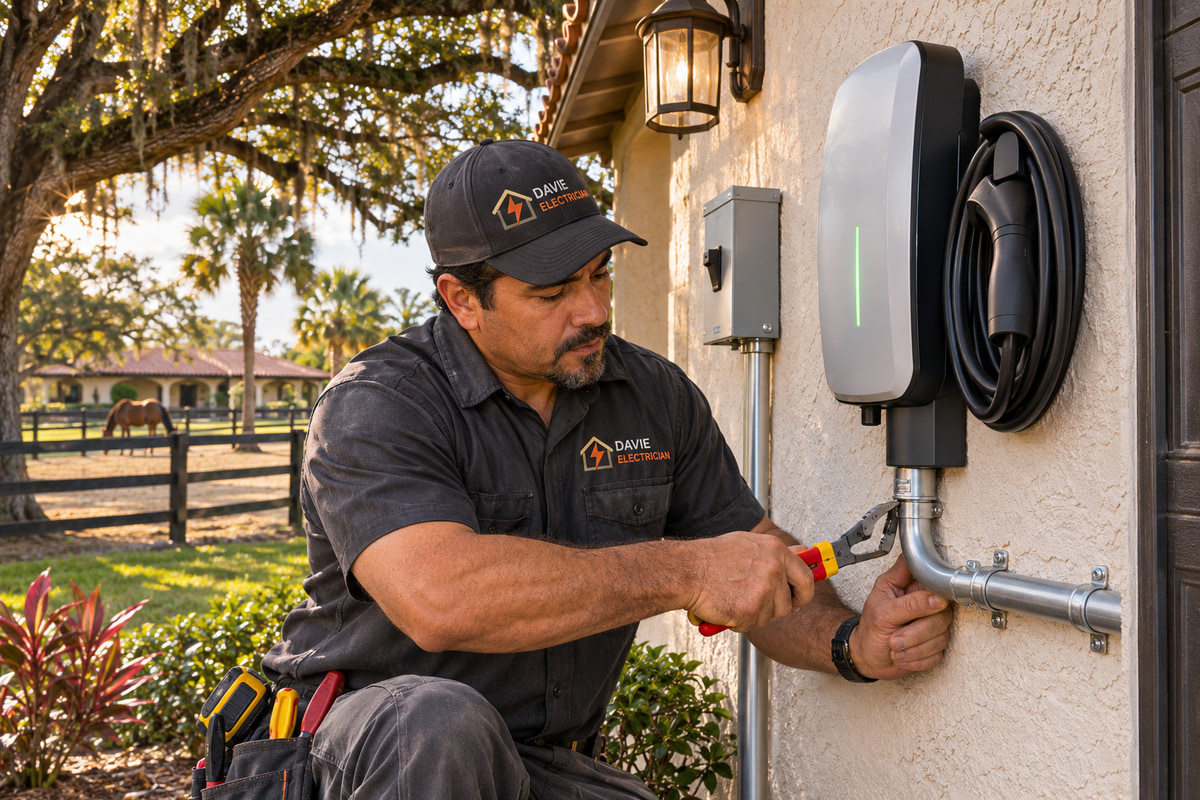
Two worlds along one road, and the electrician who has to understand both
There are corridors that feel like one thing from end to end. Griffin Road through Davie is not one of them. Along its length you find retail plazas with parking lots, signs and rows of storefronts. A short distance away you find equestrian properties with fences, paddocks, barns and shaded drives. Between them lie homes of various sizes, offices, service businesses and open land. Each of these has its own electrical character, and a person who works along this road has to switch between them within a single day.
The retail side is about capacity, code and continuity. Shops need steady power, tenants need clear divisions of responsibility, signs and parking lot lights need to work after dark, and safety systems need to be tested. Work is scheduled around business hours, and downtime costs money.
The equestrian side is about distance, moisture, dust and animals. Power has to reach barns, arenas, wash racks, wells and gates, often across long distances. Wiring must stand up to humidity, hay dust and the habits of horses, which chew, rub, kick and lean. Safety for animals and people is paramount, and the consequences of a fault in a stall are serious.
The residential side sits between, with homes that may be ordinary houses on ordinary lots, or houses on larger lots with outbuildings. They may be on well water or municipal service, with septic systems or sewers, and with a range of ages and conditions.
This page tries to be useful to all three groups. It does not claim to cover every case, and the details of your property will always matter. Our approach is the same across them. We begin with a phone conversation to understand what you have and what you want. We explain what is likely and what is uncertain. If the job is more than a simple repair, we arrange a visit, because we do not guess at work we have not seen. A quote comes afterward, and we do not promise prices in advance. Beyond that, we aim to explain what we find in plain language so you can decide what to do.
The first half of this page covers equestrian properties and their needs. The second half covers retail and commercial spaces. If you straddle both, because you run a business on a property with animals or you own a plaza next to a pasture, read both.
Equestrian property power: wells, pumps, waterers and the long way from the panel
On a property with horses, water is life, and electricity moves water. Wells, pumps, pressure tanks, automatic waterers, wash rack heaters and hose bibs all rely on power. Where the water source is far from the house, the wiring that serves it is a long, buried run that must be properly sized and protected.
Start with the well pump. A submersible pump sits down in the well and is fed by a cable that runs up to a control box or pressure switch. The supply is a dedicated circuit from the panel, usually a double pole breaker. Common problems include a pump that cycles on and off too often because of a waterlogged tank or a failing pressure switch, a pump that does not start because of a tripped breaker or failed capacitor, and a pump that runs hot because of low voltage or a restricted flow. The well contractor handles the pump and tank. The electrician handles the supply, the disconnect, the protection and the wiring to the pressure switch. They can work together.
Lightning is a frequent threat to well pumps. A strike near the well can send a surge down the cable and burn out the motor. A surge protector at the pump control box and at the panel reduces the risk. If your pump has failed after a storm, ask about protection for the replacement.
Automatic waterers and heaters in troughs are electrical devices placed in water. Their cords, plugs and connections must be in good condition and plugged into ground fault protected outlets. Horses are sensitive to small voltages, and a trough with a slight leak of current may cause animals to refuse to drink without any visible cause. If a horse seems to avoid a waterer, check it. Turn off the power, unplug the device and test with a meter, or have a qualified person do so. Fix the cause before the animal is hurt.
Wash racks and hose areas are wet places by nature. Outlets, lights and water heaters there need appropriate ratings and protection. Fixtures should be sealed, switches should be out of spray and the wiring should be protected from impact. Keep cords off the ground where water collects.
The feed from the panel to each outbuilding is a topic of its own. Our gate and site electrical page and our barn and workshop page describe feeders, subpanels and grounding in more detail. For this corridor, remember that the road is busy and the soil is often damp, and that the distance between structures is sometimes long. Plan feeders accordingly, and have buried lines located before anyone digs.
Consider a typical case. An owner builds a small wash area at the back of a barn and wants hot water, a light and an outlet. The barn subpanel has a few spaces left, but the feeder from the house was sized for lights and a fan. Adding a water heater and a pump would push it too far. The right answer might be to upgrade the feeder, to add a second feeder for the wash area or to choose a smaller heater. Making that call requires knowing the wire size, the distance and the existing loads, which is why a visit is needed. A guess would either leave the owner short of power or spend money where it is not needed.
Fans and misters in barns and wash areas also draw power, and they run in hot weather when the whole system is stressed. A misting system with a pump needs a protected circuit and clean connections. A fan hung over a stall should be hung out of reach, with a cord that cannot be chewed, on a ground fault protected circuit. These are small details that keep horses and handlers safe during the hottest months.
If your property has a security or camera system, treat it as part of the electrical plan. Cameras covering a gate or a barn aisle need power and data cables that survive weather and animals. Run them in conduit, support them off the ground and protect them with surge devices. A camera that goes down in a storm is not helping anyone.
Arena, paddock and yard lighting that works for horses, riders and neighbors
Lighting an outdoor riding area or paddock raises concerns that ordinary yard lighting does not. Horses can be startled by sudden changes in light and by glare. Riders need even illumination, without hot spots or deep shadows. Neighbors, including those with homes along the road, deserve not to be lit up. And the equipment, mounted on tall poles in the open, is exposed to wind, lightning and corrosion.
Good arena lighting is even and shielded. Fixtures are positioned and aimed so that the beam falls on the ground rather than into eyes. Poles are placed outside the riding area, and the height is chosen to spread light evenly. LED fixtures are widely used because they are efficient, last long and light up instantly. Controls such as timers and photocells keep lighting predictable. Motion sensors are generally not used in arenas, since a sudden light can startle horses.
Wiring for pole mounted lights is usually underground in conduit, rising at each pole to a junction and a disconnect. The conduit and fittings must be rated for wet and corrosive locations. Poles should be properly grounded and bonded, and the base protected from mower and tractor damage. A ground fault protected circuit is a sensible choice. Surge protection at the circuit helps with lightning, which in open ground is a particular risk.
Lights around paddocks and barn aprons should help people see to work and keep animals safe. Low glare fixtures at human height help handlers lead horses. Lights mounted high on a barn wall can be aimed down at a work area. Avoid placing bright lights where they shine into stalls at night, since horses need darkness to rest.
Voltage drop is a problem on long runs to poles. Fixtures at the far end may be dim or flicker. Proper wire size, calculated from distance and load, prevents it. Do not assume that the wire used for a short run will serve a long one.
Maintenance matters. Check poles for rust, check fixtures for water, clean lenses, and replace lamps or modules as needed. Test ground fault devices monthly. After storms, look for tilted poles, damaged conduit and burned connections. Lights that flicker, buzz or go out repeatedly are telling you something. Listen, and call.
Dust is another quiet factor. Arena footing and dry weather put fine particles in the air that settle on lenses and fixtures, reducing output and trapping heat. Wiping lenses and checking seals twice a year keeps fixtures bright and prevents early failures. Insects also move into poles and junction boxes, particularly ants and wasps, so check enclosures and keep gaskets in good condition.
Think about outlets at the arena as well. A sound system, a water truck pump, a drag or a groomer with electric controls may need power at the edge of the riding area. A weatherproof receptacle on a pole or a pedestal, ground fault protected and mounted well above ground, serves these. Extension cords across footing are a hazard for horses and riders and should be avoided.
If you are planning lighting for the first time, sketch the area and note where you ride, lead and work. Share the sketch, and we will talk about placement and circuits. Many owners find that starting small, with essential areas lit well, and expanding later, is the best path.
Retail plazas and tenant suites: panels, meters and shared responsibility
Along the commercial stretches of the road, retail plazas hold a row of small businesses under one roof line. Each suite has its own electrical needs, but they share a building. The first question for any tenant is: what is mine, and what is the landlord's?
Typically, each suite has its own meter and panel, fed from a meter bank outside or a central room. The landlord owns the building service and the distribution equipment, and the tenant is responsible for the inside of the suite, subject to the lease. Changes to the panel or the service generally need the landlord's approval, and some landlords require their own contractors or specific procedures. Always ask first.
Inside the suite, the common problems are those of a space adapted by many tenants. Circuits do not match the layout. Panel labels are wrong. Outlets are insufficient. Lighting is old or mismatched. Equipment trips breakers. The remedy begins with a survey: map the panel, count the circuits, measure the loads, and compare with what the business needs. Then plan changes that are permitted and neat.
Different businesses stress the system differently. A restaurant wants heavy kitchen circuits and good ground fault protection. A salon wants many small appliance circuits. An office wants outlets and clean power for computers and a network. A retail shop wants lighting and a few outlets at the counter. A fitness or service business may want large air conditioning capacity and specialized equipment. Always bring information about the equipment you plan to install.
Permits are part of the process. Most commercial electrical work needs a permit and an inspection, and the landlord often wants copies. Plan for that in your schedule. Opening day can be delayed when electrical inspections come late, so build in time.
Our guide on tenant buildouts and retail electrical explains how a new space moves from empty shell to working shop. Our guide on exit signs and emergency lighting explains how to maintain life safety lighting. These pages complement this one. A visit to your suite is needed before pricing any buildout, since each space has its own surprises.
A frequent surprise is the ceiling. Above the tiles in an older plaza suite you may find wiring from several former tenants, abandoned cable, fixtures with no known switch and junction boxes that were covered over. Each of these is a safety concern and a coordination challenge. Before new lighting is installed, the old wiring should be traced, removed if abandoned and properly terminated if live. This work takes time, and it is easier to do before the new ceiling goes in.
Another is the shared neutral. In some older commercial wiring, a single neutral serves several circuits. If a breaker is turned off for work, the neutral may still carry current from the other circuits. This is why testing is essential and why shutting off one breaker is not proof that a wire is safe to touch. Qualified electricians test before touching, every time.
Signs, parking lot lights and exterior power along a busy road
A business on a busy road depends on being seen. Signs, parking lot lights and exterior lighting at entrances make a business visible and safe at night. They are also among the most exposed electrical systems on a property.
Pole signs and monument signs run on dedicated circuits, often fed from the landlord's panel or the tenant's panel through underground conduit. They have controls such as photocells or timers. When a sign goes dark, the reasons include a tripped breaker, a failed control, a bad transformer or power supply, a loose connection in the sign base, or water in the housing. Because signs are high and sometimes involve high voltage components, repairs should be left to qualified people. If you see a sign flashing, buzzing or sparking, turn off its circuit and call.
Parking lot lights sit on tall poles with underground feeds. The most common failures are lamp or fixture failures, photocell failures, failed ballasts or drivers and wiring damage from vehicles striking poles or from digging. A pole that is leaning, a base that is cracked or a handhole cover that is missing is a safety hazard. Rust at the base of a pole may point to moisture.
Exterior lighting at entrances and loading areas should be bright enough to see by and shielded to avoid glare. Many jurisdictions have rules about light levels and about light spilling onto neighbors. Local rules decide, and we advise you to check with the landlord and the local office.
Outdoor outlets at plazas, used for events, holiday lights and equipment, should be on ground fault protected circuits and equipped with weatherproof covers. Holiday decorations deserve extra care: use rated cords, avoid overloading outlets and place connections where they will not sit in puddles.
Electric vehicle charging is appearing in some parking lots. If a plaza or business wants to add chargers, the capacity of the service and the distribution to the parking area must be examined. This is a project for the landlord and a qualified electrician, with permit, utility coordination and careful design. It is a topic we are glad to discuss.
Finally, security cameras and access controls, now common at businesses, need power and data wiring. Plan routes, weatherproofing and surge protection from the start. A camera that loses power during a storm is no use when you most need it.
Bridging the two worlds: planning, visits and what to prepare
Whether you are an equestrian property owner, a plaza tenant or someone with a foot in both, a little preparation makes the process smoother.
Before calling, gather basic information. What is the property? What is the problem or project? When did it start? What has been tried? Who else is involved: a landlord, a well contractor, a gate company, a sign company? Do you have paperwork, such as plans, permits or manuals? Photos of the panel, the equipment and the problem area help.
On the call, describe what you see and hear. We will ask questions and give general information. If the job is simple, we may be able to discuss it directly. If not, we will suggest a visit. We do not give prices for work we have not seen, but we will explain what a quote involves and when you can expect it.
At the visit, expect the electrician to walk the property or suite, look at the panel and equipment, take measurements and ask questions. On equestrian properties, make sure animals are secured. On commercial premises, let staff know. The electrician will explain what was found and what the options are. Where permits are required, they are discussed, and the local office decides what applies.
After the visit, you will receive a quote for the work. Compare it with your needs, ask questions, and decide. If you prefer to stage the work, say so. We can often separate urgent items from items that can wait.
During the work, expect careful practice: lockout of circuits, testing, neat installation and cleanup. After the work, expect testing and an explanation. Keep records.
Maintenance afterward is simple. Test ground fault devices. Inspect cords and plugs. Keep equipment clean and dry. Report symptoms early. After storms, check outdoor equipment and boxes.
Griffin Road's variety is part of Davie's character. A well maintained electrical system, whether it powers a barn light or a shop sign, supports the life that goes on along it. If you would like to talk through your situation, call and describe it. We will take it step by step.
Settings along Griffin Road
- Griffin Road retail plazas: tenant suites, shared meters and exterior lighting and signs.
- Equestrian properties near Griffin Road: wells, waterers, barns and arena lighting.
- Homes on larger lots: outbuildings, gates and long feeders.
- Offices and service businesses: small commercial suites with growing equipment.
Nearby corridors
The University Drive corridor and the Flamingo Road corridor both run through Davie with their own character, and each has a page. The main Davie page gives the overall picture.