

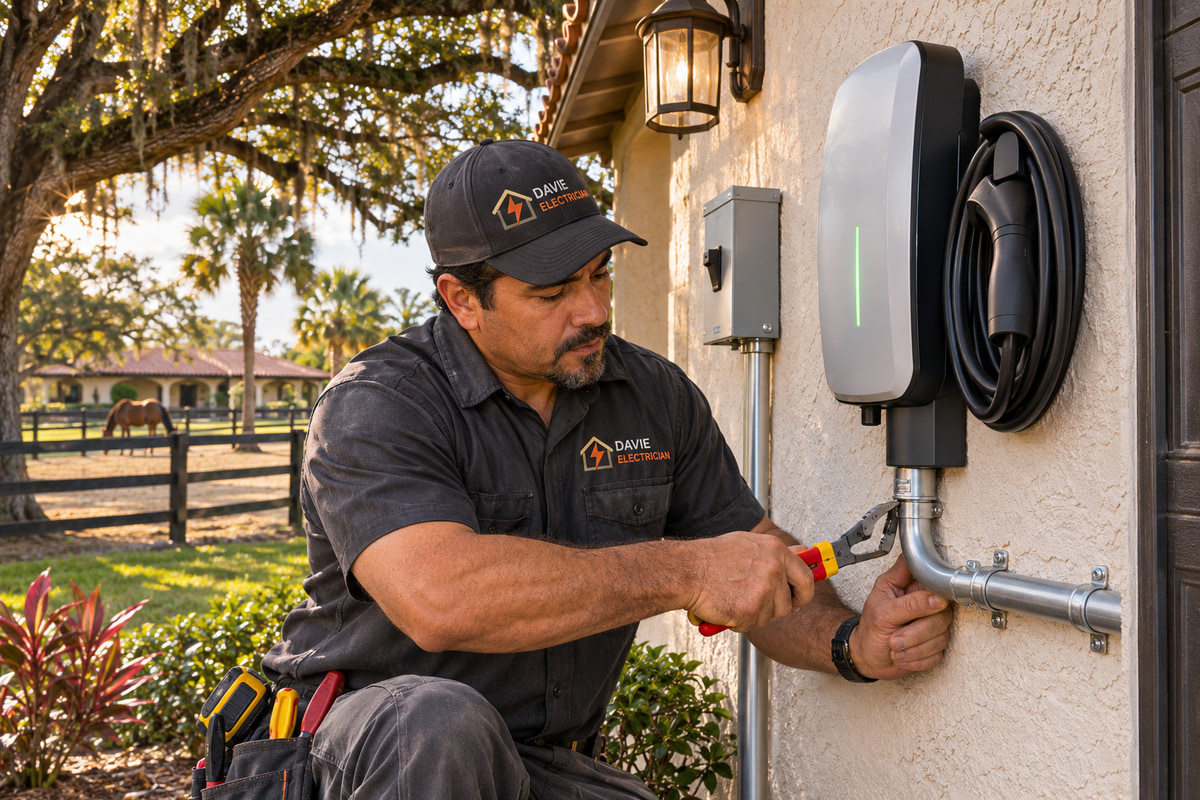
Western heritage, wide open ground and what it means for wiring
Davie has long been known as a town with a western flavor, and the rodeo grounds are one of the places that keep that identity visible. Open fields, arenas, fences, stock pens and parking areas define the landscape, and the buildings around them tend to be practical structures: barns, announcer stands, concession buildings, storage sheds and shaded seating. Nearby are homes on larger parcels, where owners enjoy space for animals, trucks, trailers and workshops. The wiring on such land looks different from what you would find on a typical suburban block.
Open ground changes how electricity behaves in subtle ways. Distances are longer, so wire has to be heavier to keep voltage steady. Buildings stand apart, so each needs its own protection and often its own subpanel. There are fewer tall objects to take a lightning strike, so the ones that exist, such as light poles, trees and metal roofs, matter more. And the ground itself is often damp or soft, which influences how cable can be buried and how equipment is grounded.
People who own or manage such land often inherit a patchwork. A barn built decades ago may have had lights added by one owner and outlets added by another, with a mix of wire types that cannot be seen without opening walls. A concession stand may have a new refrigerator on an old circuit. An announcer booth may have a power strip plugged into another power strip. These stories are not unusual, and none of them is a reason to be embarrassed. They are simply the normal result of a property being used and adapted over time.
A good starting point is to treat the whole property as one electrical system, even if it was built in pieces. Draw a rough map of the main service, the feeders to each building, the panels, the poles and the gates. Note what works, what trips, and what you suspect. That simple sketch gives an electrician a head start and gives you a lasting record, which is valuable on land that may be worked on by many people over the years.
What a venue or event space asks of its power
A rodeo or similar event is a short, intense demand on electricity. A normal day on the grounds might require only lighting and a few outlets. An event day brings sound systems, scoreboards, floodlights, food vendors with grills and refrigerators, ticket booths with card readers, and extra lighting in the parking field. If the permanent electrical system was designed for ordinary days, event days stretch it. Breakers trip, lights dim, and the sound system hums. Good planning can prevent the embarrassment of a blackout in the middle of an announcement.
The key to event power is knowing the loads in advance. List every device that will run, note its power rating, and sort the list by what runs at the same time. A deep fryer, a refrigerator and a coffee urn are heavy hitters. A string of lights is usually modest. Add them up and compare the total to the capacity of the circuit and the panel. If the numbers do not work, options include adding circuits, bringing in a temporary power distribution unit, or staging the use of equipment so the peak is lower. A conversation with an electrician before the event is far less stressful than troubleshooting during it.
Permanent upgrades to a venue pay off over many seasons. Dedicated circuits for the concession area, labeled outlets at the vendor lanes, weather rated receptacles with ground fault protection, and a sensible layout for the sound and lighting controls all make event days smoother. If the venue hosts events regularly, a distribution panel designed for temporary connections, with locking connectors and clear labeling, is a long term improvement over a patchwork of extension cords.
Safety for the public must also be considered. Cords across walkways are trip hazards, and connections on wet ground are shock hazards. Covers for cords where people walk, raised connection points that stay out of puddles, and ground fault protection on every circuit feeding outdoor equipment all lower the risk. Organizers should be clear about who is responsible for each vendor connection and have a person who knows where the main disconnects are at all times.
Here is a worked example of a load tally for a modest event. Suppose the plan calls for a sound system, two floodlight banks, six food vendors and a ticket table. The sound system and ticket table are small, perhaps a single circuit between them. The floodlight banks, depending on fixture type, may each need a circuit of their own. The vendors are the difficult part: a trailer with a grill, a fryer and two refrigerators can use as much power as a small house. If all six plug into one distribution point, the total may exceed what it can supply. The solution is to assign vendors to separate circuits, ask each vendor for their equipment list ahead of time, and have a clear layout of which outlet serves which space. This is not complicated, but it must be done before the gates open, not after the first breaker trips.
Lighting for the parking field is another event day need. Temporary light towers are common, but permanent poles with proper fixtures give safer, steadier light and avoid the noise and fumes of portable units. Their placement should cover entrances, walkways and the path between the parking area and the seating. Controls should allow the lights to come on automatically at dusk and be switched off by a person at closing time, with a manual override for early arrivals.
Temporary power, portable generators and portable loads
Temporary power is part of life around a venue. Vendors arrive with their own equipment, a stage may need a stand alone supply, and a special event in the field may be far from any permanent outlet. Portable generators fill the gap, but they have rules. A generator must be placed outdoors, away from windows, doors and vents, because its exhaust contains carbon monoxide, which can be deadly. It must be grounded and connected according to the maker's instructions, and refueling should happen only when the engine is cool and off.
Connecting a generator to a building is where mistakes become dangerous. Plugging a generator into a wall outlet to power a house or building is called backfeeding, and it can send electricity back to the utility lines and injure workers repairing them. The safe way is a transfer switch or an interlock device installed by a qualified electrician, which isolates the building from the utility while the generator is running. A properly installed inlet at the building makes it simple to connect the generator with a proper cord, and gives the event team a reliable method for outages as well.
Cord selection matters more than it seems. A thin extension cord feeding a heavy load will heat up, and a long cord will drop voltage at the far end. Choose cords rated for outdoor use, with the proper wire size for the load and the distance, and avoid coiling a cord that is carrying a heavy load, since the coil traps heat. Inspect cords for cuts and exposed wire before each event. Replace any cord with a damaged plug, as a loose plug blade can overheat and arc.
For regular events, consider installing weatherproof outlets in strategic locations around the grounds, with in use covers and ground fault protection. Having power where it is needed reduces the use of long cords and makes the site safer and neater. A simple layout drawing that shows the location and capacity of each outlet helps vendors plan, and helps volunteers answer questions without a scramble.
Rural lots and outbuildings in the surrounding area
Homes around the rodeo grounds are often on large lots with a main house and a collection of other buildings. A detached garage, a workshop, a pole barn, a pump house or a stable may stand a long walk from the panel. Each of them needs a safe power supply, and the way that supply is run can make or break the system. Overhead lines are cheaper to install but are exposed to storms and trucks. Underground lines in conduit are more protected but require trenching and careful depth. Whichever route is chosen, the wire size must suit the distance and the load.
The panel at the main house is the starting point, and it needs to have enough capacity and spare spaces. Many older houses on large lots have service panels that were sized for a house alone, and when a workshop with a welder or a barn with fans is added, the margin disappears. Before running a feeder to a new building, an electrician will calculate the total demand and compare it to the main breaker, which may lead to a service upgrade.
A subpanel at each outbuilding is a good practice. It allows the building to be shut off at its own location, keeps the wiring inside organized, and protects the feeder with a breaker sized for its wire. The subpanel needs a proper ground arrangement, which for a separate building generally involves its own ground rods and a ground wire from the main panel. This is a code detail that is easy to get wrong, and one that an electrician should confirm instead of leaving to guesswork.
Inside the outbuilding, think about what you will do there. A workshop wants bright light, many outlets at bench height, and a few heavier circuits for tools. A stable wants sealed fixtures and conduit protected from animals. A pump house wants a weather rated disconnect and a circuit sized for the motor. Planning the layout on paper before installing anything helps ensure that outlets end up where the work happens rather than where the stud spacing happened to fall.
One more consideration is the difference between a feeder and a branch circuit, a distinction that confuses many owners. A feeder is the heavy supply that runs from the main panel to a subpanel in another building. A branch circuit runs from a panel to the lights and outlets themselves. Each has its own rules for wire size and breaker size, and mixing them up leads to either an overpriced installation or an unsafe one. When you receive a quote for outbuilding wiring, ask the electrician to explain the feeder size and why it was chosen, and to describe how much future capacity it leaves. A feeder sized for today's needs only may have to be replaced if the workshop grows, and digging a trench twice costs far more than choosing a slightly larger wire the first time.
Fencing and metal structures deserve a note as well. A metal fence or pipe rail that touches an energized wire can become live along its length, and a person or animal touching it in wet conditions could be shocked. Overhead lines should be kept clear of fences, flagpoles and tall equipment, and any metal structure near electrical equipment should be bonded when required. If you ever notice a tingle when touching metal on your property, stop and call for help immediately. It is a warning, not an annoyance.
Lightning, flooding and wet ground
Florida summer afternoons bring thunderstorms with dramatic lightning, and open grounds are particularly exposed. A strike does not need to hit your building to harm it. A nearby strike can induce a surge in overhead lines, in buried cables and in fences that carry current across the ground. Protection comes in layers: a surge protective device at the main panel, additional protection at subpanels and at sensitive equipment such as sound systems, gate operators and cameras, and good grounding throughout. Outdoor event organizers should have a clear plan for moving people to shelter when storms approach, since no electrical protection helps someone standing in an open field.
Grounding deserves special mention. A ground system connects the electrical system to the earth, giving unwanted energy a safe path. Rods driven into the soil, connections to metal water pipes, and the bonding of metal parts all form part of it. In sandy or rocky soil the connection may be poor, and in damp soil it can corrode. A periodic check of ground connections, especially at outbuildings and poles, helps keep the system effective.
Wet ground is another factor. Heavy rain can saturate fields and flood low spots, and electrical equipment in those spots is at risk. Panels and disconnects should be mounted above the likely high water mark, conduits should be sealed so that water cannot enter and travel along them, and buried junction boxes should be rated for wet locations. If a low area of the property floods, avoid placing outlets or equipment there, or raise them on posts with weather rated enclosures.
After a storm or flood, treat any equipment that got wet with caution. Do not turn on a panel or outlet that has been submerged. Turn off power at the main breaker if you can do so safely from a dry location, and call for help. Water in electrical gear can leave a hidden film that causes a short later, and equipment that has been soaked often needs replacement rather than drying out. It is a hard conversation, but a safe one.
A few habits reduce risk before the next storm. Walk the property in daylight and look at poles, pedestals and outdoor panels for cracked covers, missing knockouts and signs of insects or nesting animals. Check that every outdoor receptacle has a working cover. Look for cables lying exposed where mowers or tractors pass. Note any tree limbs that lean toward overhead lines and report them to the utility rather than trimming them yourself, because working near energized lines is dangerous. Write down what you find, and fix the simple items promptly. Small repairs made calmly cost less than the same repairs made after weather has turned a loose part into a failure.
Planning a visit and keeping good records
Start with a phone call describing what you own or manage and what you need. For a venue, mention the kind of events held, the largest loads, and any recurring problems. For a rural home, mention the outbuildings and the distances. A quote comes after that conversation, and complicated jobs need a visit to see the layout. Walking the property is especially important on large parcels, because the wire runs and conditions cannot be judged from a distance.
On the day, be ready to show the electrician the main panel, subpanels, and any known problem spots. Share your sketch of the property if you made one. Mention buried utilities you know of, such as water lines, irrigation and gas, so that any trenching can avoid them. If animals are present, keep them away from work areas for their safety and for the electrician's.
After the work, ask for a written summary and, if new circuits were added, an updated panel directory. Add the route of any new buried cable to your property sketch and keep it somewhere accessible. That record will help whoever digs on the property next. If the electrician notes items that should be addressed later, write them down with a rough order of priority and revisit the list once a year.
Finally, think about the calendar. Events, hurricane season and heat all arrive on a schedule you can anticipate. Scheduling an electrical review a few weeks before the busiest period gives time to fix problems without rushing. A small amount of planning turns electrical work from an emergency into a routine, and allows the owners and volunteers who run such properties to focus on what they enjoy.
The feel of the area around the rodeo grounds
This part of Davie keeps the open, western character the town is known for. Fenced fields, long driveways, barns and trucks parked beside workshops are common sights, and the pace is slower than in the commercial corridors. The rodeo grounds anchor the area's identity, and many neighbors take pride in the heritage the grounds represent.
Homes in the area range from older ranch style houses to larger custom homes built on spacious lots. Many owners keep animals, store equipment or run small businesses from their property, which means the electrical system often does more than a typical house would. A home based business with a shop, a stable and a guest cottage can have more circuits than a small plaza.
Because properties are larger and further apart, utility service lines are longer and storm damage can be more dramatic. Trees near lines, wind on open ground and lightning strikes all play their part, and residents often develop a practical approach to preparation, with a generator ready, a list of what to unplug and a good relationship with someone who can check the wiring.
Nearby areas we also serve
Pine Island Road, with its shopping centers and residential communities, is close by, and Flamingo Gardens and the surrounding rural lots lie to the west. The Orange Drive area, with its horse properties, shares much of the same open land character. Each of these has its own page on this site.
Plantation Acres to the north and Southwest Ranches to the west offer similar larger lot living, and the questions raised here about outbuildings, long feeders and lightning apply there as well.