

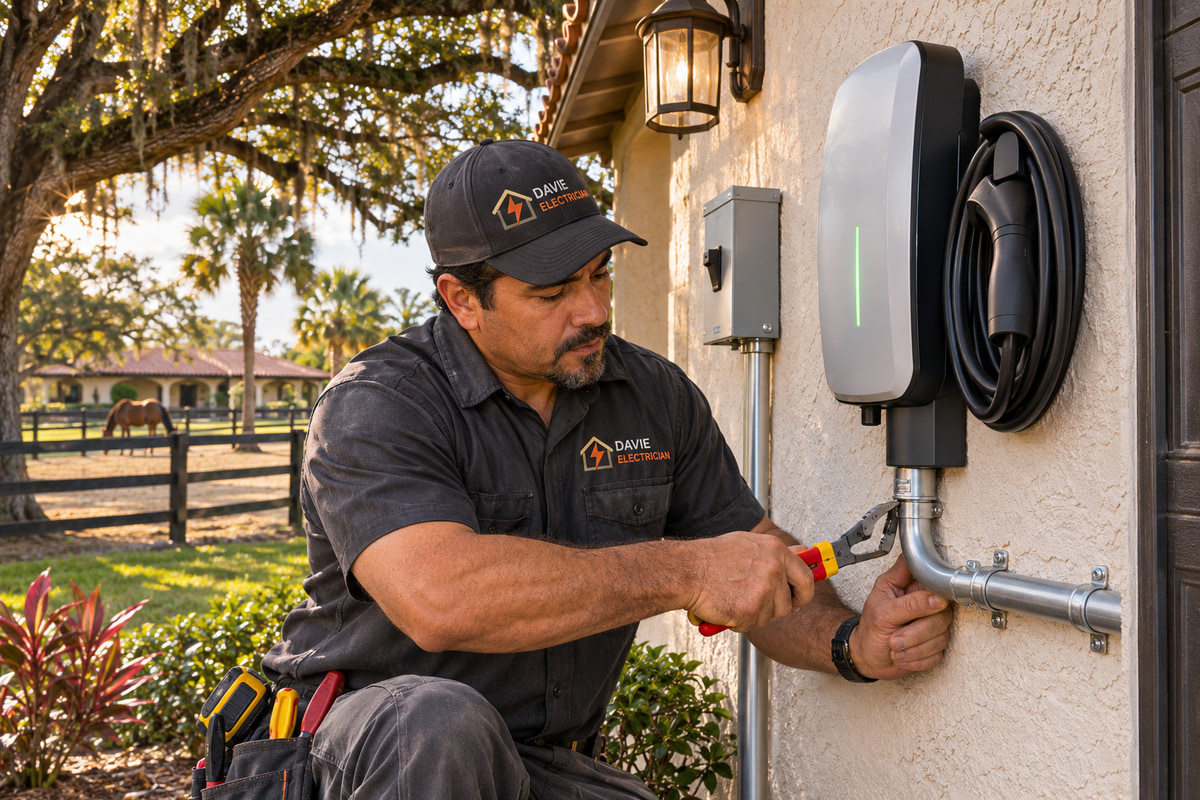
Open space, tall trees and open sky: how weather meets a golf community home
Homes beside a golf course enjoy something rare in suburban life: a long view. Across the fairway, trees, water and sky stretch out, and the house feels bigger for it. That same openness means that weather arrives without much interruption. Summer afternoon storms can roll across the open ground with strong wind and lightning, and tall trees on the course and in yards are natural targets.
Lightning does not need to strike a house to harm its electrical system. A nearby strike on a tree, a pole, a pond or the ground sends energy into the surrounding earth and along any conductor it can find, including power lines, cable lines, phone lines, buried irrigation wires and metal pipes. The result is a surge: a brief, sharp rise in voltage that rushes into the house through those paths. Most of the damage is invisible at first. A television may stop working, a router may reset, an air conditioner control board may fail, a pool controller may go dark, or a garage opener may stop responding. Sometimes the failures appear days later, as weakened components finally give up.
Understanding the pathways is the key to reducing harm. Surges enter through the electrical service, through the cable or internet line, through any telephone or alarm lines, through outdoor wiring such as lighting, irrigation and pool equipment, and through metal piping. A defense that covers only one of those pathways leaves the others open. This is why protection works best in layers.
It also helps to know the limits. No device can promise to stop a direct strike. Protective devices reduce the energy of a surge to a level that most equipment can survive, and they greatly improve the odds. Combined with good grounding, they are the standard approach. Neither a surge protector nor a good ground connection replaces the other.
Residents of Arrowhead who have lived through several storm seasons often have a story: a modem lost, a pool pump motor burned out, a television that went dark. If that sounds familiar, take it as a sign to look at your protection and your grounding. We approach the topic through a conversation by phone first, and if a visit is needed to examine the service, the grounding and the equipment, we arrange it. A quote comes after we understand your home.
Layers of surge protection: panel, equipment and the lines that enter the house
Think of surge protection as a series of gates. The first gate sits at the main panel, where power enters the house. A surge protective device installed there absorbs a large share of a surge before it can spread to every circuit. The second gate sits at individual valuable equipment, where plug in protectors or built in protection catches what gets past the first. The third gate covers the other lines: cable, internet, phone and alarm connections. Each gate reduces the energy that reaches the next.
The panel device is installed by a qualified electrician, because it involves connecting to the panel's bus bars with the correct breaker and short, direct wiring. The length of the wires matters. The shorter and straighter the connection, the better the device performs. A device installed with long, looped leads is less effective. Panel devices come with status lights or alarms that show whether they are still working. A protector that has absorbed too many surges eventually wears out and needs replacing. Check the indicator occasionally.
At the equipment, choose protectors with a clear rating and, ideally, indicators that show protection is still active. A cheap power strip without real protection gives a false sense of security. Pay particular attention to televisions, computers, home theater gear, networking equipment, medical devices and anything with a delicate circuit board. Plug the modem, router and any connected devices into the same protector, so that a surge coming in over the data line does not find a path through the power connection.
Bonding and grounding make everything else work. A surge needs somewhere to go. The grounding system, including the grounding electrode and the bonding of metal piping, gives it a path to the earth. If grounding is old, corroded, disconnected or missing, protective devices cannot do their job well. A quick inspection of the grounding connections at the panel and where cables enter the house is a worthwhile check. The connections between power, cable and phone grounding should be tied together, so that no dangerous voltage difference develops between systems.
Outdoor equipment is vulnerable. Pool pumps and controllers, irrigation controllers, landscape lighting transformers and outdoor cameras each connect to long outdoor wires that act like antennas. Dedicated protection at each, or at the subpanel that feeds them, is a sensible measure. Our page on whole house surge protection goes through the equipment options.
A sample walk through helps. Suppose a homeowner has lost a modem and a television in two summers. The electrician starts at the service: is there a surge device at the panel, and if so, is its indicator lit? Is the grounding electrode connected and the bonding of the cable entry in place? Then to the equipment closet or the media shelf: are the devices on real protectors or on simple strips? Then outdoors: are the pool pump, the irrigation controller and the lights protected? In a short visit, the pattern of weak points appears, and the fixes are specific rather than general.
Timing helps too. Many people add protection after a loss. Adding it in the quiet months, before the wet season begins, means it is in place when the first big storm rolls in. Check protective devices again after a very close strike, because a device may have taken a heavy hit and need replacing even though everything seems to work.
None of this requires panic. It requires a plan, a small investment compared with replacing equipment, and a willingness to check the devices periodically.
Lighting that makes a home easier and safer to live in
A home that has served its owners for many years often develops small mismatches with the people who live in it. Eyes change, balance changes, routines change. Good lighting and well placed controls are among the simplest ways to make a house easier to live in, and they are among the most practical electrical improvements for any household.
Begin with the paths you walk at night. From the bedroom to the bathroom, from the bedroom to the kitchen, from the front door to the entry hall. Low level lights along these paths, activated by motion sensors or plug in night lights, reduce the risk of a fall. Step lights on stairs and at thresholds are also valuable. Soft, warm lighting avoids glare.
Next, consider switches. Standard toggle switches can be hard to operate for some people, and rocker switches with a larger surface are easier. Switches at both ends of a hallway or at the top and bottom of stairs, called three way switching, spare you from walking in the dark. A switch inside each entrance, including the garage entry, means you never enter a dark room. Illuminated switches show their location in the dark.
Task lighting matters in kitchens and baths and over reading chairs and workbenches. A bright, even light over a countertop, a mirror light that shows faces clearly and a lamp positioned beside a chair make daily tasks easier. Under cabinet lights and lights inside closets and pantries remove the need to feel around.
Outdoor lighting should welcome and protect. A well lit front entry, a path light along the walk, a light at the garage and a light at the back door help with arrivals after dark. Motion sensors are useful, but they should be set to ignore small animals and passing cars. For homes beside the course, shielded fixtures that point downward keep the glow where it is needed and keep it out of neighbors' windows.
Finally, consider smart controls with care. Voice or app control can be a real convenience for people who find it hard to reach switches. But complicated systems that confuse users are not an improvement. Choose a setup that you or your family can operate simply, and always keep ordinary wall switches working as a backup.
Comfort systems, aging equipment and the electrical side of staying cool
In this climate, comfort means cooling. An air conditioner runs for much of the year, and the circuits that feed it, the disconnect near the outdoor unit and the control wiring all work hard. As equipment ages, its electrical side changes, and it deserves occasional attention.
Look at the outdoor unit's disconnect box. It should be intact, with a secure cover and no signs of burning, melting or rust. Look at the wiring that enters the unit. The insulation should be sound and the conduit should be firmly attached. Look at the pad. If it has shifted, the lines may be strained. Keep vegetation clear so air can flow and technicians can reach the equipment.
If your breaker for the air conditioner trips, warm weather, a dirty filter or coil, a failing capacitor or a stressed compressor may be to blame. Do not keep resetting the breaker. An air conditioning technician looks at the equipment, and an electrician looks at the supply and the wiring. Working together, they resolve it. If you smell burning, see smoke or hear loud buzzing from the unit or its disconnect, turn off the breaker and call at once.
Other comfort loads add up. Water heaters, dryers, ranges and pool equipment are all large consumers. If your home has had a number of equipment replacements, the circuits that serve them may not match. A replacement unit with different requirements can overload an old circuit. Always check the specifications before the new equipment is installed.
Ceiling fans, too, play a role in comfort. A fan lowers the felt temperature and allows you to set the air conditioner a little higher. Old fans can become noisy and unbalanced, and replacements are more efficient. Make sure the fan box is rated for the job. When a fan is replaced, think about the control as well. Many older fans were controlled by a wall dial that regulates speed with an electronic part inside. If the new fan uses a different kind of motor, the old control may make it hum or run poorly, and a control matched to the fan is the right answer. Remote controls built into the fan can also be handy for people who prefer not to stand on a chair or reach for a chain.
Water heaters deserve a line. An electric water heater runs on a dedicated circuit with a heavy wire and a double breaker. If the water goes cold, the cause might be an element, a thermostat or a tripped breaker. The wiring at the heater should be tight, the cover should be on, and the area around it should be dry. Any sign of leaking water near electrical connections calls for shutting off the breaker at once. A heater in a garage or closet should have its circuit labeled so that anyone can turn it off in an emergency.
And remember to use the reverse switch, if your fan has one, according to the season, though South Florida seldom calls for much heat.
If you are thinking about energy savings, start with the simple things: replace old bulbs, use timers on outdoor lights, and have your cooling checked. Large savings do not come from tiny gadgets, but from the large systems working properly.
Bathrooms, kitchens and the upgrades that make them both safer and nicer
Kitchens and bathrooms are the rooms where homeowners most often spend money, and they are also the rooms where electrical details matter most because of water. A remodel is a chance to bring wiring up to date.
In bathrooms, ground fault protection is essential. Outlets near sinks, tubs and showers should be protected, and lighting near wet areas should be rated for it. Exhaust fans remove moisture, and a fan that is noisy, weak or stuck allows humidity to build up, which damages finishes and wiring. A fan with a timer or humidity sensor helps. Heated floors and heated mirrors are comfortable additions, and they need their own circuits and controls. Vanity lighting with dimmers allows a gentle level at night and a bright level in the morning.
In kitchens, appliance circuits should match the equipment. Ranges, wall ovens, dishwashers, disposals, microwaves and refrigerators each want a circuit appropriate to their needs. Countertop outlets should be on small appliance circuits with ground fault protection. If you replace a range or oven, check the plug and receptacle type, the wire size and the breaker. A mismatch can cause overheating. Never swap a breaker for a larger one to stop it from tripping.
Lighting layers make a kitchen work: general light overhead, task light under cabinets and accent light where it is wanted. Dimmers on each layer give flexibility. Choose lamps with a color temperature that makes food and faces look natural.
A remodel is also a time to look behind the walls. If the home has older wiring in the kitchen or bath, replacing it while the walls are open is far easier than doing so afterward. Aluminum wiring in some homes of certain eras requires special attention and connectors made for it, and an electrician can tell you whether you have any. Cloth covered wire, if found, should be replaced. And any splice should be inside an accessible box.
A short story illustrates the point. A couple replaced their kitchen cabinets and countertops, then found that the new island blocked the only outlet on that wall. Rather than run a cord across the floor, they asked for an outlet in the side of the island. That requires a circuit run beneath the floor or through the cabinet, ground fault protection and a location that complies with the rules for islands. If it had been planned before the cabinets were ordered, the run could have been made easily. Because it came afterward, the work was more involved. The lesson is that electrical planning belongs at the drawing stage, not the finishing stage.
Similar planning applies to bathrooms with new tubs or showers. A fan, a heater, lights and outlets must be located relative to the wet zones, and some fixtures may not be allowed above a tub. Ask for the fixture's rating, and share it before ordering.
Permits apply to many of these projects. The local office decides what applies at your address, and an inspection protects you. Planning early with the electrician and the other trades prevents rework. We are glad to talk through the electrical side of any remodel.
Making a plan that fits your pace and your budget
Not every improvement needs to happen at once. The goal is a house that is safe, protected and pleasant, reached step by step. Here is a way to think about order.
First, safety. Any hot, loose, scorched, exposed or wet wiring should be handled first. A breaker that will not hold, a switch that crackles, a cord that is cracked and an outlet that is warm are all items for immediate attention. So is any shock or tingle when touching an appliance or metal fixture.
Second, protection. Surge protection at the panel, ground fault protection where water is present and arc fault protection where required add layers of defense. Smoke and carbon monoxide alarms belong here too. These items are modest in cost and large in value.
Third, reliability. Replace worn devices, tighten connections, label the panel, and make sure essential equipment such as refrigeration and medical devices is on dependable circuits. If you have equipment that matters during an outage, discuss backup options.
Fourth, comfort and convenience. Lighting upgrades, additional outlets, fans, dimmers and smart controls make a home more pleasant. They can be scheduled with other projects.
When you are ready, call and describe your home. Tell us how long you have lived there, what has been changed, what has gone wrong and what you would like to improve. We will ask questions and suggest an approach. Simple repairs may be quoted after the conversation. Anything larger begins with a visit, because we do not guess at work we have not seen, and we do not promise prices ahead of understanding the job.
A well cared for home in Arrowhead can continue to serve its owners comfortably for many more years. With attention to storms and surges, safe lighting, healthy equipment and sensible upgrades, the electrical system becomes something you rarely have to think about, and that is exactly how it should be.
What we see around Arrowhead
- Homes facing the golf course: open exposure to weather and wide views.
- Residential streets with pools: pool equipment and screened patios.
- Homes with long histories: kitchens and baths updated on top of earlier wiring.
- Tree lined lots: mature trees near lines and outdoor equipment.
Close to Arrowhead
Westridge lies not far away with newer homes, and the Nova Southeastern University area is nearby with a mix of homes and businesses. Each has its own page. The main Davie page offers the wider overview.